Master’s Degree using a synergy of remote sensing and in situ observations to examine the ability to detect mesoscale and submescale eddies in the Northwestern Mediterranean Sea and the Nordic Sea.
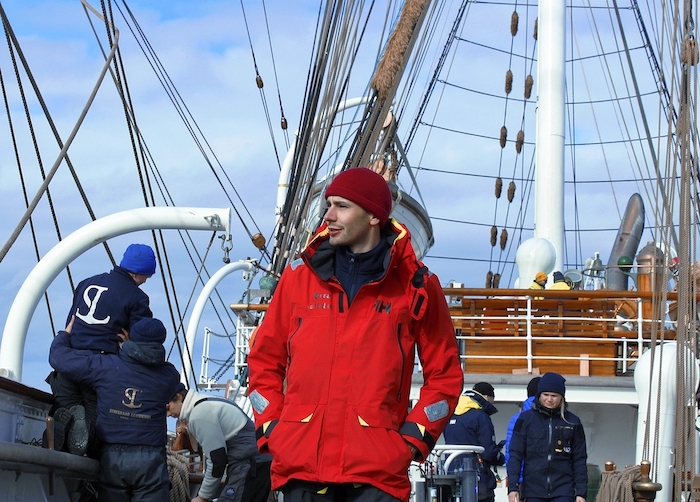
Martin Cornille has recently completed a dual Master’s degree at the crossroads of engineering and ocean science, between ENSTA (École nationale supérieure de techniques avancées) and IUEM (Institut Universitaire Européen de la Mer).
SWOT AdAC: What is your field of research and how did you choose it?
Martin Cornille: I first followed an intensive undergraduate preparation in advanced Mathematics and Physics for the competitive entrance exams to French Graduate Engineering Schools. During this rigorous training, I developed a strong interest in Physics. This scientific discipline appeals to me because it reflects the human desire to provide rational explanations for observed phenomena. But with a form of humility and admiration for the natural beauty of the order of things. In fact, if wanting to put the world into equations requires a certain audacity, one must always consider physical theories as models that approach the truth without ever reaching it.
Motivated by this outlook, I chose ENSTA, an engineering school strongly connected to scientific research, particularly in oceanography. My interest in eddy dynamics began during an academic project supervised by Xavier Carton, carried out while completing a Degree in Physics (equivalent to a bachelor’s degree) in parallel with my first year at ENSTA.
This first experience convinced me to pursue a Master’s degree focused on Deep Ocean Dynamics at IUEM. Through interactions with researchers, I gradually refined a personal research project to apply for the ESA Ocean Training Course 2025 (#OTC25). I proposed to evaluate SWOT’s capabilities in detecting fine scale features. In the same time, I was fortunate to obtain a 5-month research internship aligned with this topic, supervised by Anthony Bosse at the Mediterranean Institute of Oceanography (MIO) in Marseille. From April to November 2025, I conducted my end-of-study project jointly through the OTC25 and my internship at MIO.
SWOT AdAC: How is your field of research related to SWOT?
MC: My Master’s thesis assessed the added value of high-resolution SWOT-based altimetry for detecting mesoscale and submesoscale eddies, focusing on the Northwestern Mediterranean Sea and the Nordic Seas. Using a synergy of remote sensing and in situ observations, I examined the ability of remote sensing to detect smaller and deeper eddies during both the Cal/Val and Science phases.
The study first evaluated the consistency and complementarity between satellite altimetry products (DUACS, MIOST, VarDyn) and in situ data collected during the BioSWOT-Med campaign (2023) in the Northwestern Mediterranean Sea, and the ESA OTC25 campaign (2025) in the Nordic Seas. Then, I compared the performances of the conventional nadir altimetry product DUACS, and two experimental SWOT-enhanced products (MIOST and VarDyn), in detecting and tracking eddies using the SHOOT eddy detection algorithm (developed by Jean-Baptiste Roustan from the SHOM). I finally worked on vertical reconstruction of identified fine-scale ocean structures using in situ measurements — including vessel-mounted ADCP and glider-based hydrographic profiles. These datasets enabled the characterization of several key vortices, such as the BioSWOT-Med eddy and the Lofoten Basin Eddy (LBE).
SWOT AdAC: What do you find exciting about SWOT and the SWOT-AdAC campaign in which you have participated and how did you contribute to the campaign?
MC: Working on this topic has significantly reinforced my passion for physical oceanography and my fascination with the power of satellite observations. What thrills me most about SWOT is the remarkable correspondence between remote sensing and in situ measurements. Seeing glider-derived dynamic heights align with SWOT-based altimetric features is extremely stimulating — it gives a tangible sense that we are truly observing the same ocean from two very different perspectives. Yet some discrepancies remain, and understanding these gaps is essential for better interpreting the physics captured by these two complementary approaches.
I am also deeply fascinated by the unprecedented level of detail provided by SWOT. The fine-scale structures revealed in the wide-swath observations are not only scientifically valuable but visually striking : the sharpness and complexity of the signal offer a new way of “seeing” the ocean. This richness opens exciting perspectives for future research.
Finally, I am greatly inspired by the idea that SWOT is only a first step. The prospect of seeing fully operational wide-swath altimeters launched in the future — delivering continuous fine-scale global observations — is incredibly motivating. Knowing that our current work contributes to preparing the scientific community for this next generation of missions fills me with enthusiasm and a strong desire to keep pushing in this field.
SWOT AdAC: What are your future plans?
MC: I plan to continue working with the MIO to further develop the research initiated during my Master’s thesis. I also intend to apply for the ESA Graduate Trainee (EGT) Programme, which offers recent graduates the opportunity to gain hands-on experience in the development and operation of space missions within a dynamic international environment.