What drives phytoplankton diversity at fine scales?
Publications | BioSWOT-Med Blog | Book
Phytoplankton diversity is a key component in ocean biogeochemical cycles and contributes to the resilience and health of ocean ecosystems in respect to local and global stressors, including climate change. Understanding the mechanisms behind phytoplankton diversity in the open ocean is a matter of concern, especially in these years in which large Marine Protected Areas are created in international waters and the an international legally binding treaty on Marine Biodiversity Beyond National Jurisdiction has been negotiated.
Model studies suggest that fine-scale ocean dynamics are an important driver of plankton diversity and several scenarios have been suggested. In situ observations however are difficult to perform, due to the ephemeral nature of fine-scale features and the difficulty of tracking them from available remote sensing. This observational limit has been largely reduced by the SWOT mission, in particular during the fast sampling phase, which opened new possibilities to biophysical experiments in the open ocean.
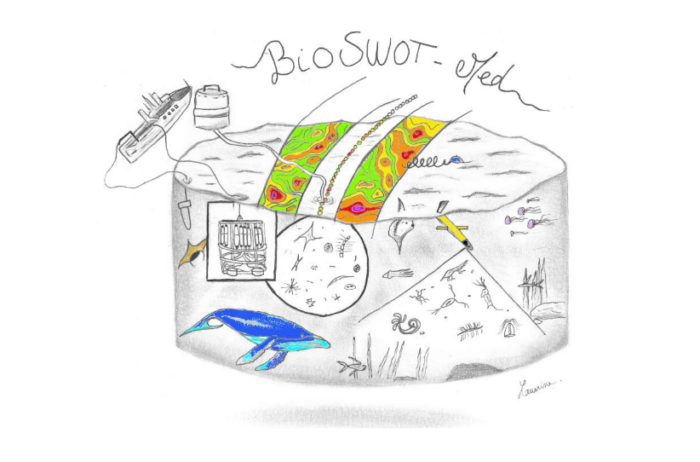
The BioSWOT-Med cruise (https://doi.org/10.17600/18002392) was the main study site for CNES during SWOT fast-sampling phase. Guided by early SWOT images, it located a fine-scale front in the northwestern Mediterranean Sea and adopted an adaptive Langrangian sampling strategy to gather an unprecedented high-resolution dataset of physical and biological variables across and within the front as well as in a nearby fine-scale eddy.
The first four scientific papers from the cruise challenge assumptions about the physical and biological functioning of marine ecosystems in low energy and low nutrient conditions. Results might apply to the other oligotrophic and moderately energetic regions of the global ocean and provide indication for future developments of earth system models and biogeochemical models.
Principal investigators: Andrea Doglioli (); Gérald Gregori (
), Francesco d’Ovidio (
).
Institutes involved in the campaign: AMU, LOCEAN, CEA, CNR, CNRS, CSIC, Fisheries and Ocean Canada, IFREMER, IRD, MBARI, NWRA, OGS, SHOM, Sorbonne Université, SZN, UCSD, ULCO, University of Exeter, University of Washington.
Contact point for the study site: Andrea Doglioli ().
The BioSWOT-Med cruise took part onboard R/V L’Atalante and is one of French Oceanographic Cruises (DOI: 10.17600/18002392).
Check out the BioSWOT-Med blog or read the book People, science and instruments of the BioSWOT-Med campaign
Publications
Challenging physical and biological assumptions on the structure and functioning of marine ecosystems in low energy/ low nutrient concentration. The BioSWOT-Med cruise was the main study site for CNES during SWOT fast-sampling phase. Guided by early SWOT images, it located a fine-scale front in the northwestern Mediterranean Sea and adopted an adaptive Langrangian sampling strategy to gather an unprecedented high-resolution dataset of physical and biological variables across and within the front as well as in a nearby fine-scale eddy. The first four scientific papers from the cruise challenge assumptions about the physical and biological functioning of marine ecosystems in low energy and low nutrient conditions. Results might apply to the other oligotrophic and moderately energetic regions of the global ocean and provide indication for future developments of earth system models and biogeochemical models.
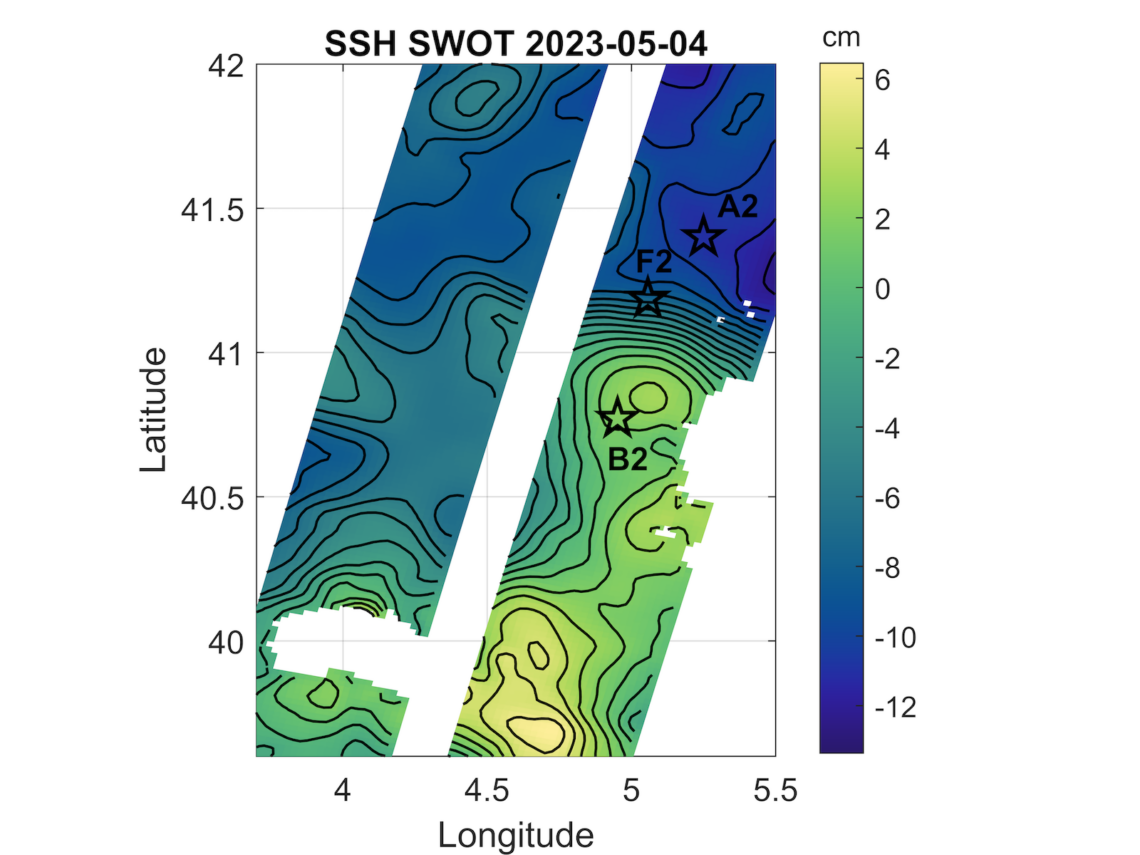
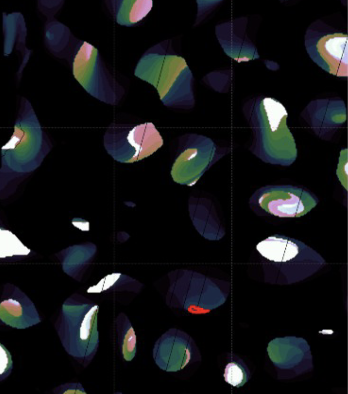
SWOT reveals that fine-scale eddies are as efficient as larger and more energetic structures in modulating turbulence in the ocean interior. Using data collected during the fast-sampling phase of the SWOT satellite, a study published on Journal of Geophysical Research: Oceans shows that fine-scale eddies (<100 km) in the Northwestern Mediterranean Sea are as efficient as large and intense structures found in western boundary currents and the Antarctic Circumpolar Current system in transferring wind energy into the ocean interior. These findings might apply to the rest of the global ocean characterized by low energy and thus provide a new challenge to parameterize this process in Earth system models.
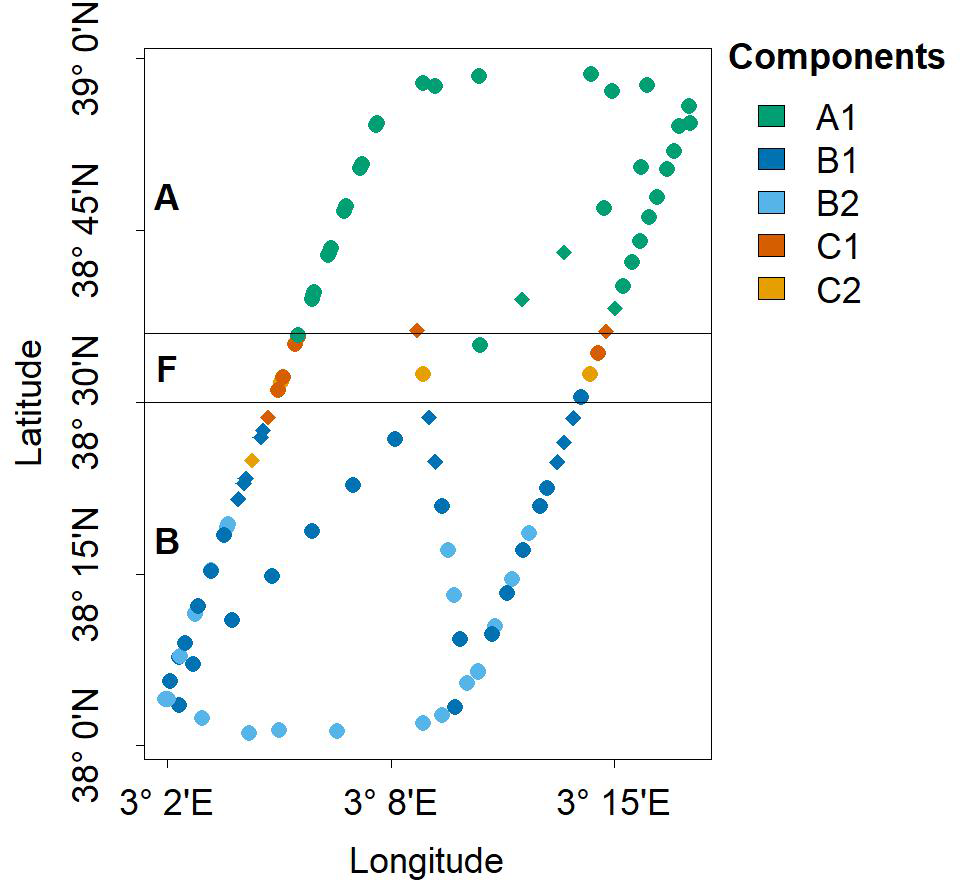
A new study developed a generative statistical approach to reanalyse a scarce and highly variable phytoplankton dataset collected in a frontal zone in the South of the Balearic Islands in 2018. The method will be applied to larger datasets, including both global satellite analyses and in situ data (nutrients, fluxes, phytoplankton, zooplankton and grazing rates) such as those acquired during the BioSWOT-Med campaign.
Investigating zooplankton at SWOT scales in the NW Mediterranean: a legacy of François Carlotti.The first detailed investigation of zooplankton distribution at fine scales in the North Balearic Front has been published in Biogeosciences. The work was carried out during the BioSWOT-Med cruise under the coordination of François Carlotti. François, who passed away earlier this January, has been a pioneer in the study of zooplankton from the polar oceans to the Mediterranean Sea.
All publications
| Year | Citation | DOI |
|---|---|---|
| 2026 | Ohman, M.D., Leblanc, K., Ellen, J.S. and Gastauer, S. (2026), Giant phytoplankton revealed by in situ imaging. Limnol. Oceanogr. Lett, 11: e70163. | https://doi.org/10.1002/lol2.70163 |
| 2026 | Demol, M., Ponte, A. L., Garreau, P., Bellacicco, M., Berta, M., Centurioni, L. R., Doglioli, A.M., Joël, A., Mourre, B., Pascual, A., 2026. Large drifter experiment in the Western Mediterranean Sea reveals dynamical versus noise contributions in SWOT-KaRIn sea level. Geophysical Research Letters, 53, e2025GL121425. | https://doi.org/10.1029/2025GL121425 |
| 2026 | Oms, L., Doglioli, A., Messié, M., D’ovidio, F., Capet, X., Rousselet, L., Joel, A., Izard, L., Lévy, M., Berta, M. and Petrenko, A., Bellacicco, M., Barillon, S., Grand, L., Pulido-Villena, E., Nunige, S., Leblanc, K., Courtois, B., Zhang, W., Grégori, G., 2026. Fine-scale observations reveal distinct frontal phytoplankton communities. Communications Earth & Environment, 7(1), p.468. | https://doi.org/10.1038/s43247-026-03350-0 |
| 2026 | Joël, A., Doglioli, A.M., Bosse, A., Bouruet‐Aubertot, P., Buniak, L., Capet, X., d’Ovidio, F., Grégori, G., Martellucci, R., Mauri, E. and Menna, M., Moutin, T., Nunige S., Pacciaroni, M., Rolland, R., Rousselet, L., Pulido-Villena, E., 2026. Ocean circulation modulating the nutrient distribution and fluxes at regional and fine scales: A case study in the Northwestern Mediterranean Sea. Geophysical Research Letters, 53(10), p.e2025GL120726. | https://doi.org/10.1029/2025GL120726 |
| 2026 | Rolland, R., Bouruet‐Aubertot, P., Cuypers, Y., Bosse, A., Petrenko, A., Maytie, T., Ponte, A., Barrillon, S., Berta, M., Mourre, B. and Pascual, A., Izard, L., Capet, X., Grégori, G., d’Ovidio, F., Doglioli, A. M., 2026. Near‐inertial wave trapping inside a fine‐scale anticyclonic eddy during the BioSWOT‐Med 2023 cruise: Turbulence and energy flux. Journal of Geophysical Research: Oceans, 131(3), p.e2025JC022984. | https://doi.org/10.1029/2025JC022984 |
| 2026 | Garcia, T., Oms, L., Milhaud, X., Doglioli, A.M., Messié, M., Vandekerkhove, P., Lacour, C., Grégori, G. and Pommeret, D., 2026. A statistical approach to unveil phytoplankton adaptation to ocean fronts. Advances in Statistical Climatology, Meteorology and Oceanography, 12(1), pp.21-41. | https://dx.doi.org/10.5194/ascmo-12-21-2026 |
| 2025 | Duranson, M., Berline, L., Guilloux, L., Della Penna, A., Ohman, M.D., Gastauer, S., Cotte, C., Bănaru, D., Garcia, T., Berta, M., Doglioli, A., Grégori, G., d’Ovidio, F., Carlotti, F., 2025. Fine scale zooplankton distribution across the North Balearic Front during late spring. EGUsphere, 2025, pp.1-36. | https://doi.org/10.5194/egusphere-2025-1125 |
| 2025 | Rousselet, L., d’Ovidio, F., Izard, L., Della Penna, A., Petrenko, A., Barrillon, S., Nencioli, F., Doglioli, A., 2025. A Software Package for an Adaptive Satellite-Based Sampling for Oceanographic Cruises (SPASSOv2. 0): Tracking Fine-Scale Features for Physical and Biogeochemical Studies. Journal of Atmospheric and Oceanic Technology, 42(8), pp.979-990. | https://doi.org/10.1175/JTECH-D-24-0071.1 |
| 2024 | Oms, L., Messié, M., Poggiale, J.C., Grégori, G. and Doglioli, A., 2024. Fine-scale phytoplankton community transitions in the oligotrophic ocean: A Mediterranean Sea case study. Journal of Marine Systems, 246, p.104021. | https://doi.org/10.1016/j.jmarsys.2024.104021 |
| 2023 | Demol, M., Maristella, B., Gomez-Navarro, L., Izard, L., Ardhuin, F., Bellacicco, M., Centurioni, L., D’Ovidio, F., Diaz-Barroso, L., Doglioli, A., Dumas, F., Garreau, P., Joël, A., Lizaran, I., Menna, M., Mironov, A., Mourre, B., Pacciaroni, M., Pascual, A., Ponte, A., 2025. A Drifter Dataset for the Western Mediterranean Sea collected during the SWOT mission calibration and validation phase. EmodNet Ingestion duplication. | https://doi.org/10.17882/100828 |