What is the contribution of finescales in heat fluxes in the ACC standing meander south of Tasmania?
The Southern Ocean is a major player in the heat and carbon uptake and transport, with the Antarctic Circumpolar Current (ACC) being the strongest current in the world, with hotspots occurring where the current interacts with topographic features.
In the region called ACC standing meander South of Tasmania (ACC-SMST) there is one of these hot spots with a high eddy heat flux. The objective of the ACC-SMST campaign was to describe the dynamics of the ACC in this region, including current-topography interactions and smaller scale dynamics testing using observations and modelling. The Fast Sampling Phase crossed the ACC right in the meander hotspot and the site of strong meso and sub-meso scale signals, including significant internal tides, internal waves, submesoscale eddies and a strong wave regime.
In situ observations were planned with a nominal plan to have moorings deployed, floats, drifters and gliders profiling across the area on top of a full oceanographic cruise which would do intense section profiling and shallow CTD and other sampling on top of underway Physics and BGC. The campaign benefited from the concomitant in-situ/satellite observations and smaller scale processes understanding to better monitor the heat fluxes in the ACC-SMST and circumpolar over the whole science phase of the satellite. The campaign was planned for the early science phase taking advantage of the latitude factor which made coverage of the area every 5 days, allowing for a synoptic SWOT coverage to interpret and follow the smaller scale features and benefit from the Fast sampling phase 1 day repeat SWOT data to solve for and map the stationary internal tides.
The investigations carried out within the ACC-SMTS region have been put in the context of a larger investigation of the Antarctic Circumpolar Current dynamics in a circumpolar view, taking advantage of the higher resolution offered by SWOT.
The ACC-SMST campaign represented a unique effort to observe some of the most energetic ocean signals in the ACC where the measurements from SWOT may be noisier given the large waves regime while in situ measurements are always a challenge in the Southern Ocean.
In December 2023, a second team was onboard the French Antarctic Supply ship, the Astrolabe, to provide fine resolution temperature profiles from 0-800m depth by XBT, along a triangular section surrounding the ACC-SMST experimental site (see Figure below). Every year, seasonal temperature profiles are collected from October to March every 1-2h (10-20 nm) as part of a 30-year monitoring of vertical ocean heat content changes between Australia and Antarctica, the SURVOSTRAL Project (www.legos.omp.eu/survostral). During December 2023, more intensive temperature profiles were made every 20 mins (3 nm) as the ship crossed fronts and each time that SWOT passed over the ship tracks.
This SURVOSTRAL contribution is jointly funded by the French Polar Institute (IPEV), INSU via the SNO-SSS at LEGOS, the CNES SWOT Project, and the CSIRO, Australia.
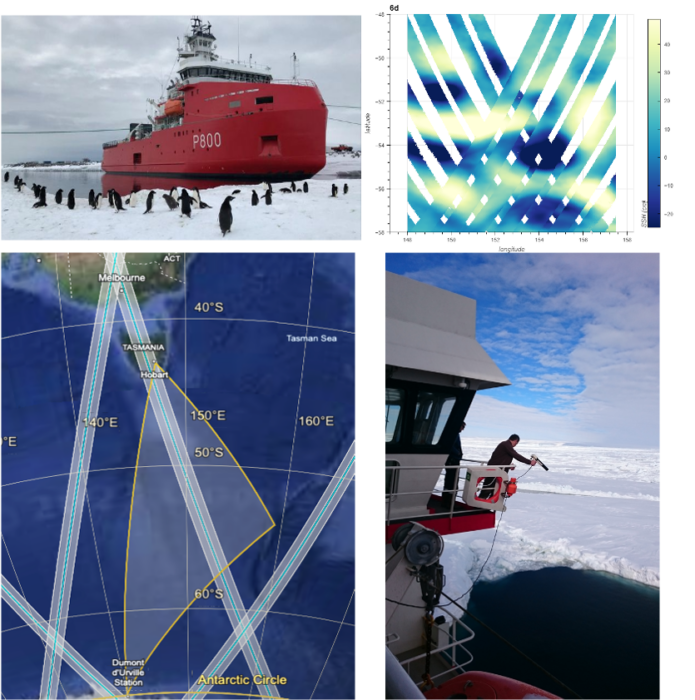
Very high resolution XBT temperature profiles will be collected by the Astrolabe (top left) during December 2023, along the triangle (bottom left) from Hobart (42.9°S, 147.3°E) to Macquarie Island (54.6°S, 159°S) to Dumont D’Urville in Antarctica (66.7°S, 140°E). An example of the SWOT coverage over 6-days in a subset of this region is shown (top right). South of 62°S, profiles will be made in the sea-ice zone (bottom right).
Principal investigators ACC-SMST: Benoit Legresy () (Climate Science Centre, CSIRO Australia), Helen Phillips (
) (IMAS, University of Tasmania, Australia), Maxim Nikurashin (
) (IMAS, University of Tasmania, Australia), Steve Rintoul (
) (Climate Science Centre, CSIRO, Australia), Kurt Polzin (
) (Woods Hole Oceanographic Institution, USA), Randolph Watts (
) (University of Rhode Island, USA), Nathan Bindoff (
) (IMAS, University of Tasmania, Australia), Rosemary Morrow (">
) (LEGOS, France).
Contact point for ACC-SMST: Benoit Legresy ().
Principal Investigators SURVOSTRAL VHR: Rosemary Morrow (LEGOS, France; ), Elodie Kestenare (LEGOS, France,
), Rebecca Cowley (Climate Science Centre, CSIRO, Australia;
), Benoit Legresy (Climate Science Centre, CSIRO, Australia;
)
Contact point for SURVOSTRAL : Rosemary Morrow (LEGOS, France, )