Using data collected during the fast-sampling phase of the SWOT satellite, a study published on Geophysical Research Letters documents the presence of high-frequency Coastal Trapped Waves (with periods of 8-10 days) over the Patagonian Shelf. The Patagonian Shelf is characterized by a complex topography and Coastal Trapped Waves can play a significant role in modulating the currents and nutrient fluxes that influence its high productivity.
The paper “First insights from SWOT fast sampling phase: high frequency coastal trapped waves over the Patagonian Shelf” published on Geophysical Research Letters investigates Coastal Trapped Waves over the wide and highly productive Patagonian Shelf. These waves are known to play a role in modulating currents and nutrient fluxes in coastal areas. SWOT data suggest that in the Patagonian Shelf they have a period of 8-10 days.
The work used data from track #22 and #7 of the SWOT satellite during its 1-day repeat orbit in spring and summer 2023, as well as the experimental multi-mission Level 4 (L4) sea level product called Multiscale Interpolation Science Topography (MIOST) which incorporates all altimetry satellite data including SWOT KaRIn measurements.
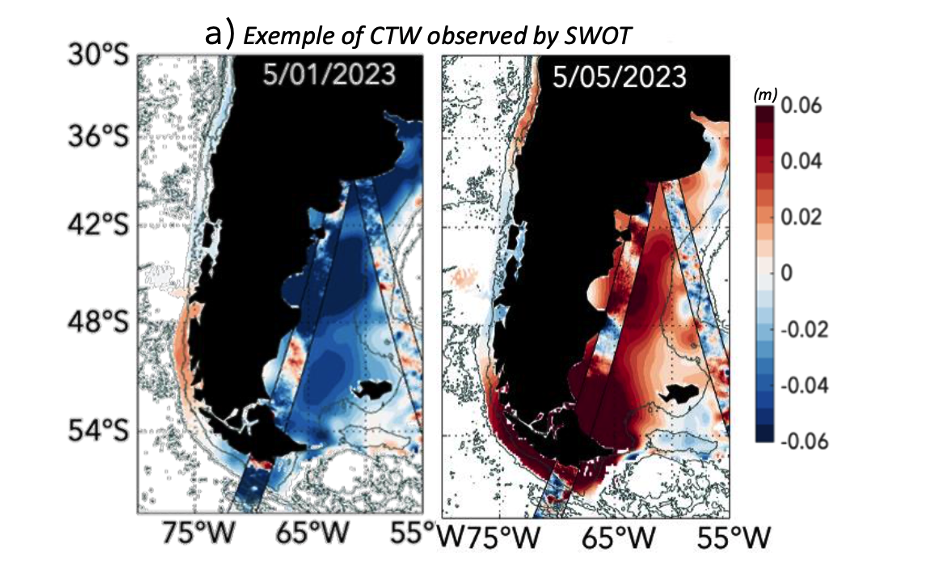
Snapshots of an event observed with MIOST sea level anomaly and SWOT swaths measurements superimposed. Credits: Poli et al. 2025.
Impacting coastal dynamics and ecosystems
Coastal trapped waves play a central role in shaping the coastal variability, in particular via modulation of vertical and horizontal velocities and temperature impacting ecosystems and human activities (Figure 1).
“Signals of high-frequency coastal trapped waves were suggested by observations and model outputs but not documented until now. Spectral analyses of in situ velocities measured by currentmeters deployed over the Patagonian shelf break showed energy peaks at periods smaller than 10 days which we were not able to explain. In addition, those high frequency signals were also present in high resolution models. However, the limited temporal resolution of the satellite altimetry data available so far did not allow a direct observation of the physical phenomena” says Léa Poli researcher at LOCEAN-IPSL and Mercator Ocean International and first author of the study.
Poli explains that the 1-day SWOT sampling phase represented an unprecedented opportunity in satellite altimetry’s history to explore the rapid changes of the ocean surface at periods down to 2 days: “SWOT fast-sampling phase provided us an answer, the energetic peak present in observations and model outputs correspond to high-frequency costal trapped waves”.
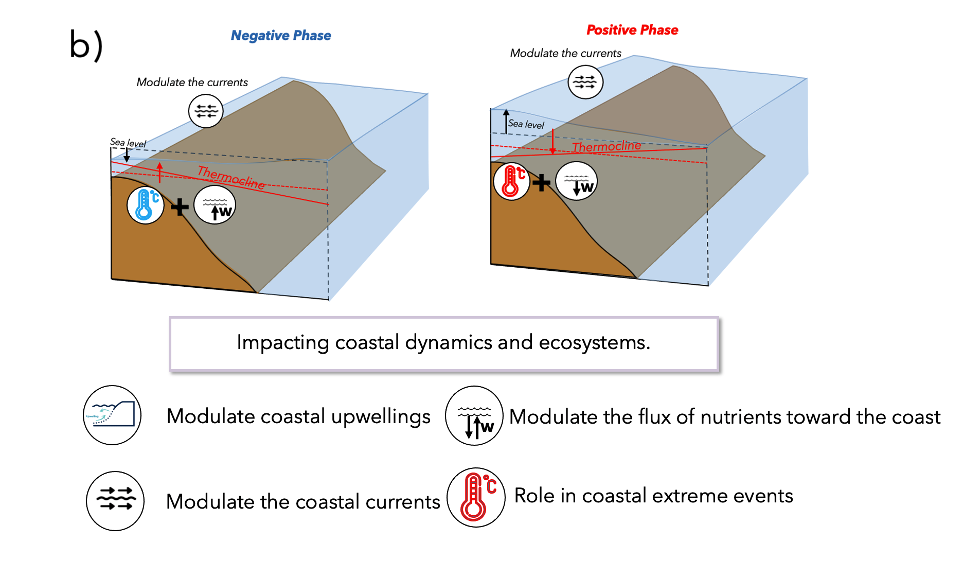
Schematics of the impact of coastal trapped waves on the circulation and temperature. Credits: L. Poli.
Improved ability to observe coastal trapped waves worldwide
Coastal trapped waves occur along continental margins worldwide. They are forced by both local winds and remote wind forcing, particularly from equatorial regions, and their periods range from days to months. Poli explains that most observational evidence for these waves come from coastal tide-gauge measurements, which provide long time series but are spatially limited.
“The SWOT satellite has improved our ability to observe coastal trapped waves. For example, a recent study along the Australian coastlines demonstrated that the inclusion of SWOT data in satellite products such as MIOST allows access to sub-monthly frequencies that were previously unresolved by conventional altimetry. This represents a significant step forward in monitoring and understanding the dynamics of coastal trapped waves and their wind-driven variability” says Poli.
Potential practical applications
“Coastal trapped waves are able to propagate energy coherently over long distances, suggesting a potential for predictability. Indeed, along the North American coast in the Pacific Ocean, accounting for coastal trapped waves has been shown to improve forecasts of coastal sea level. In addition, in the Atlantic Ocean, coastal trapped waves have been identified as a key process in the development of Benguela Niños, warm coastal events along the upwelling region that strongly impact marine ecosystems” says Poli.
The work was supported by French spatial agency Centre Nationales Etudes Centre National d’Etudes Spatiales (CNES) and is a contribution to the CNES-funded BACI and SWOT-SWATI projects.
Other relevant papers on coastally trapped waves:
- Passaro, M., 2025. Can satellite altimetry observe coastally trapped waves on sub-monthly timescales?. Ocean Science, 21(5), pp.2663-2679. https://doi.org/10.5194/os-21-2663-2025