A new study developed a generative statistical approach to reanalyse a scarce and highly variable phytoplankton dataset collected in a frontal zone in the South of the Balearic Islands in 2018. The method will be applied to larger datasets, including both global satellite analyses and in situ data (nutrients, fluxes, phytoplankton, zooplankton and grazing rates) such as those acquired during the BioSWOT-Med campaign.
The paper, ‘A statistical approach to unveil phytoplankton adaptation to ocean fronts‘, has been published in Advances in Statistical Climatology, Meteorology and Oceanography. The study developed a generative statistical approach to reanalyse a scarce and highly variable phytoplankton dataset collected in a frontal zone in the South of the Balearic Islands, Western Mediterranean Sea, in 2018.
SPECIFIC PHYTOPLANKTON COMMUNITIES CAN EMERGE IN FINE-SCALE OCEANIC FRONTS
“Our reanalysis revealed that, within the front, a new community distinct from those in adjacent water masses accounts for 70% of the frontal community. This indicates that specific phytoplankton communities can emerge in fine-scale oceanic fronts” says Théo Garcia, first-author of the study.
Despite the difficulty in observing and sampling such physical structures, which results in a limited number of frontal observations, the Bayesian modelling approach applied in the study provides statistical evidence of the influence of the front on phytoplankton community composition, allowing to overcome data scarcity and high variability.
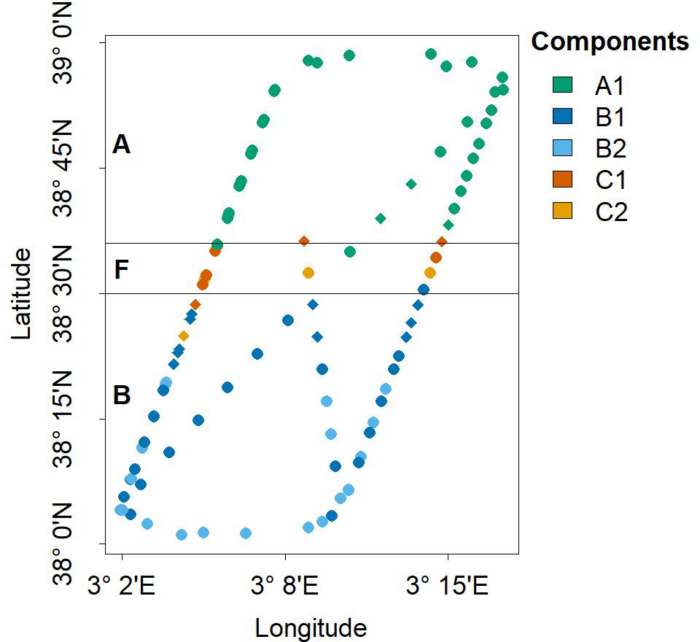
Spatial distribution of the phytoplankton modeled communities. Shapes and colors representing their community and sub-community classification, identified as the dominant component and sub-component of the Gaussian mixtures model applied to the data set. Copyright: Garcia et al. 2026
A METHOD THAT CAN BE USED WITH SWOT DATA ON PHYTOPLANKTON
The method applied in the study reshaped the understanding of a moderately energetic front in the western Mediterranean Sea, previously seen as merely a hydrodynamic boundary between two communities. Indeed, results from the reanalysis suggest the frontal zone represents a distinct ecological environment where a unique community emerged.
This “refuge effect” of the front needs further validation. The authors plan to investigate whether fronts generally act as boundaries or foster frontal-adapted communities using further datasets. In particular, the method will be applied to larger datasets, including both global satellite analyses and in situ data (nutrients, fluxes, phytoplankton, zooplankton and grazing rates) such as those acquired during the BioSWOT-Med campaign.
Indeed, the method can be applied to SWOT data. SWOT measures sea surface at a high resolution. This allows to detect small physical structures that can’t be observed with conventional altimetry. “SWOT provides new opportunities to sample biological communities within these smallest physical features. Combining SWOT data, with biological in situ observations and our new statistical method, will allow us to go deeper in the understanding and the quantification of the role of the smallest fine-scale structures in biodiversity patterns” says Garcia.
The work is the result of a collaboration between statisticians (from the Institut de Mathématiques de Marseille & Laboratoire d’analyse et de mathématiques appliquées) and oceanographers (from the Mediterranean Institute of Oceanography MIO & MBARI) as part of the rODEo project (Order and Disorder in a Turbulent Ocean).
Citation: Garcia, T., Oms, L., Milhaud, X., Doglioli, A., Messié, M., Vandekerkhove, P., … & Pommeret, D. (2026). A statistical approach to unveil phytoplankton adaptation to ocean fronts. Advances in Statistical Climatology, Meteorology and Oceanography. https://doi.org/10.5194/ascmo-12-21-2026
Contact: Théo Garcia theo.garcia@univ-amu.fr
