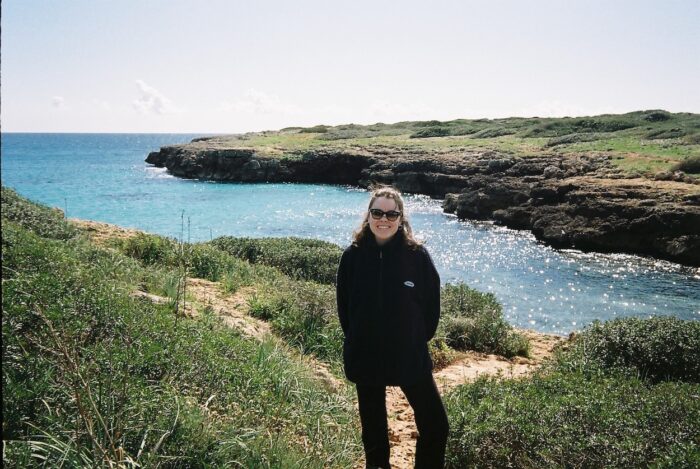
PhD student focusing on kinetic energy transfers at submesoscales in the Mediterranean Sea.
Cristina Martí-Solana holds a BSc in Physics and a MSc in Advanced Physics and Applied Mathematics, both from the University of the Balearic Islands (UIB). Currently, she is a first-year PhD student at IMEDEA (Institut Mediterrani d’Estudis Avançats, CSIC-UIB), Physical Oceanography and Climate group, Esporles, Mallorca.
What is your field of research and how did you choose it?
Cristina Martí-Solana: My research focuses on kinetic energy transfers at submesoscales (fronts, filaments and small eddies of a few to tens of kilometres) that dominate ocean dynamics below the mesoscale but have historically been very hard to observe. I’m looking at how energy moves across these scales in the Mediterranean Sea, using SWOT altimetry and in situ data (shipboard ADCP, drifters, …).
What drew me to this scale range is the observational gap: models have outpaced what we could actually measure, and submesoscale processes turn out to matter a lot for how the ocean redistributes energy, heat and nutrients, and eventually dissipates kinetic energy down to turbulence. SWOT is the first tool that lets us see these structures as 2D images rather than isolated lines, which is what makes this such an exciting moment to be working in the field.
How is your research related to SWOT?
CMS: SWOT is central to my PhD both as a data source and as motivation. My first paper (Martí-Solana et al., 2026, GRL) used shipboard ADCP observations from the CALYPSO 2022 winter cruise in the Balearic Sea to study an eddy that split in two. We found the splitting event released a burst of unbalanced-motion energy, effectively short-circuiting the classical downscale cascade. That matters directly for SWOT: the satellite measures sea surface height, from which we mostly recover the balanced, geostrophic part of the flow. But if unbalanced motions like near-inertial waves are locally energetic they can leave a signature in SSH that isn’t geostrophic, complicating the interpretation of SWOT-derived currents. Understanding when and where that happens, using in situ data as ground-truth, is exactly the synergy the SWOT calibration/validation effort is built on.
What do you find exciting about SWOT and the SWOT-AdAC campaign in which you participated? How did you contribute to the campaign?
CMS: The campaign I’m connected to is FaSt-SWOT, led by IMEDEA and SOCIB as part of the AdAC consortium. It ran sea trials in the Balearic Sea in spring 2023, during SWOT’s fast-sampling CalVal phase, combining gliders, drifters, a research vessel and HF radar. I wasn’t part of the field campaign itself, but I’m now using the data it collected to compute 2D kinetic energy transfers, extending the kind of analysis I did with shipboard ADCP data in CALYPSO to a broader, satellite dataset.
What excites me most about SWOT is exactly this: the shift from along-track lines to actual 2D images of the sea surface. For the first time we can see a front or an eddy as a shape, not just infer it from scattered crossing tracks, and compute energy transfers over an area rather than along a single line. Paired with in situ data from campaigns like this one, that’s transformative for a region like the Balearic Sea, a natural laboratory for submesoscale dynamics.
What are your plans after you finish analysing SWOT data?
CMS: I want to go deeper into the energy transfer mechanisms themselves, how balanced and unbalanced motions interact and exchange energy across scales. That’s a question that goes beyond SWOT specifically: it’s central to understanding submesoscale dynamics in general, and SWOT is just one of the tools I’d bring to it, alongside in situ data. As we saw during the CALYPSO eddy-splitting event, these unbalanced pathways can be a real gap in how we currently interpret ocean observations, not just satellite ones. New techniques like physics-informed neural networks are one route I’m interested in exploring for that, but the priority is understanding the mechanisms themselves, not committing to a specific tool yet.
Besides SWOT, are you involved in another exciting research anD do you want to share something about it?
CMS: Beyond my main work in the Mediterranean, I’m also collaborating on COUPLING II, a Spanish polar research project (ULPGC and IEO-CSIC) studying bio-physical-chemical coupling and connectivity between the Bransfield Strait and the Weddell Sea. My angle within it is looking at how SWOT performs in that environment, a useful complement to my Mediterranean Sea work, since the Southern Ocean is such a different dynamical regime for submesoscale detection. I’m also contributing to the Sea Level Thematic Assembly Centre (SL TAC) of the Copernicus Marine Service, focusing on the Southern Ocean, helping to improve the multi-mission gridded sea surface height products.