PhD student using satellite altimetry to study eddy kinetic energy in the Mediterranean Sea and focusing on understanding the drivers and impacts of the opposite trends observed across different regions.
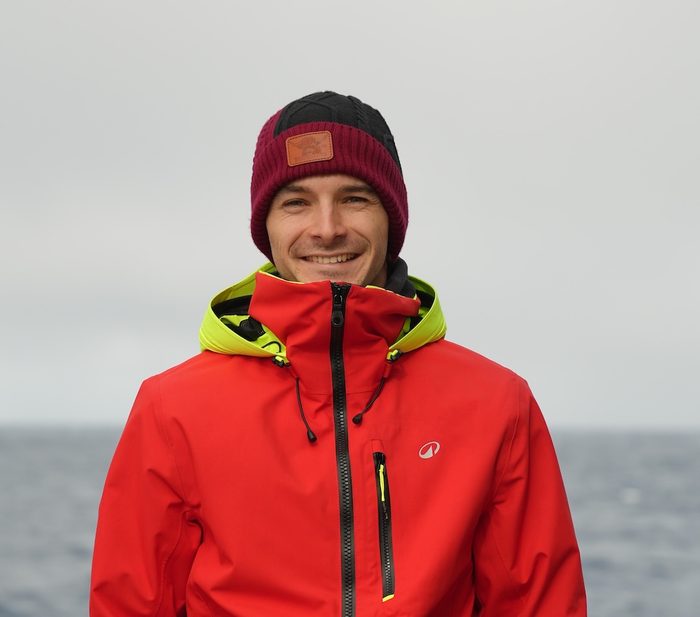
Paul Hargous holds an engineering degree in fluid dynamics from ENSEEIHT in Toulouse, France, and a Master’s degree in Ocean, Atmosphere and Climate Sciences from the University of Toulouse. Following a Master’s internship at CSIRO in Hobart, Australia, Paul is now pursuing his PhD at IMEDEA (CSIC-UIB) in Mallorca, Spain.
SWOT AdAC: What is your field of research and how did you choose it?
Paul Hargous: Growing up close to the sea strongly shaped my curiosity about understanding the ocean. Later on, the passionate and knowledgeable people I met (yes, you Benoit, Clothilde, and Treden, thank you!) ultimately guided my decision to pursue a career in physical oceanography. During my Master’s internship, I discovered the potential of satellite observations, especially as it coincided with the SWOT cal/val phase. Seeing this new mission unfold, I realized the revolution high-resolution SWOT observations would have on oceanography, making possible the study of fine-scale ocean dynamics from space.
My research focuses on mesoscale and submesoscale dynamics in the Mediterranean Sea. Often described by oceanographers as a “miniature ocean laboratory”, the Mediterranean is a unique region to study ocean processes as it is particularly sensitive to climate change and responds rapidly to environmental variations. Using conventional satellite altimetry, we have identified opposite trends in eddy kinetic energy, a metric to characterize mesoscale activity, across different regions of the Mediterranean Sea. Now, the next step is to understand the drivers and the impacts of these changes.
SWOT AdAC: How is it related to SWOT?
PH: This is where SWOT appears! In fact, mesoscale features in the Mediterranean are typically smaller than those found in the open ocean at similar latitudes, making them challenging to observe with conventional satellite altimetry. The unprecedented resolution of sea surface height provided by SWOT, particularly through its KaRIn instrument, offers a new opportunity to study these features and how they evolve. SWOT allows us to observe ocean processes at scales that were previously difficult to capture without high-resolution in situ measurements. This provides new insights into the ocean energy cascade, where energy is transferred from larger to smaller scales, and its role in the transport of heat, carbon, and other tracers.
SWOT AdAC: What do you find exciting about SWOT and the SWOT-AdAC campaign in which you participated? How did you contribute to the campaign?
PH: Although I have not had the opportunity to participate in a SWOT-AdAC campaign, I took part in the WHIRLS campaign which aimed to study small-scale ocean structures and their disproportionate role in climate processes (https://www.whirls.eu/) while providing a benchmark dataset for SWOT mission. During this campaign, I experienced firsthand how satellite altimetry, and particularly SWOT, can transform the way oceanographic campaigns are designed. SWOT data were used to identify energetic ocean features, optimize the ship’s strategy, and guide the deployment of autonomous platforms such as sea gliders, wave gliders, drifters, profiling floats…
SWOT AdAC: What are your plans after you finish analysing SWOT data?
PH: After analysing SWOT data, I hope to continue investigating how fine-scale ocean dynamics influence larger-scale circulation and climate-related processes. SWOT has opened a new window into ocean variability, and I believe that combining these observations with numerical models and complementary in situ measurements will lead to many new scientific discoveries. With the great increase in our understanding of the ocean, I hope this will encourage the development of future missions in order to enhance the satellite constellation and improve the temporal resolution.
SWOT AdAC: Besides SWOT, are you involved in another exciting research and do you want to share something about it?
PH: Beyond SWOT, I am currently investigating how the Mediterranean Sea is responding to climate change through changes in mesoscale circulation. Because environmental changes can emerge rapidly in the Mediterranean, it provides a unique opportunity to study ocean-climate interactions and their impacts on marine ecosystems. I find it particularly exciting to explore how variations in eddy activity influence the transport of heat, carbon, nutrients, and other tracers. Understanding these processes is essential for improving predictions of future ocean and climate variability.