What is the role of fine scales in horizontal and vertical exchange in the upper ocean?
Horizontal and vertical motions associated with fine scale ocean features (10-100 km), such as mesoscale and submesoscale fronts, meanders, eddies and filaments, are of fundamental importance for the distribution of heat, salt, gasses, carbon and nutrients in the ocean, thus impacting the way the ocean regulates the changing Earth’s climate. Understanding the three-dimensional (3D) dynamics associated with fine scale features and their impact on the large scale ocean circulation and climate system is one of the major international challenges for the next decade in oceanography. During the last decades, remote sensing observations of sea surface height (SSH) have significantly increased our understanding of the global ocean’s large and mesoscale circulation; eddy identification and tracking, and quantification of eddy kinetic energy. Satellite altimetry observations have the advantage of covering the global ocean in short periods of time. However, before the launch of the SWOT satellite the effective resolution of gridded SSH maps was limited, i.e. ~130 km in the Mediterranean Sea, which is insufficient to resolve the entire range of mesoscale dynamics which develop over shorter temporal and spatial scales in this basin compared to the open ocean.
The western Mediterranean Sea is a natural reduced-scale laboratory basin for the examination of processes of global importance and the FaSt-SWOT (Fine-Scale ocean currents from integrated multi-platform experiments and numerical simulations: contribution to the new SWOT satellite mission) campaign took place in the Balearic Sea during the SWOT fast-sampling phase. The general objective of the campaign was to improve the characterization of oceanic fine scales through the combined use of in-situ multi-platform and satellite data in synergy with numerical models and innovative computational techniques. Gathering a unique multidisciplinary expertise in physical oceanography, satellite remote sensing, in situ monitoring and computational science, the campaign assessed the actual capability to map SSH variability over a range of scales (30-100 km) traditionally not resolved by conventional altimeters.
A unique aspect of the FaSt-SWOT campaign was the combination of concurrent multi-scale ship-based, autonomous platform, and satellite observations with ad hoc modeling simulations, enabling the evaluation of underlying mechanisms. Taking advantage of the unique observing and high-resolution data-assimilative modeling capacities developed by IMEDEA and SOCIB teams over the recent years, FaSt-SWOT aimed to take a step further supporting the analysis and exploitation of the first SWOT high- resolution measurements. The project federated two multiplatform synoptic in situ experiments, combining glider, drifter, ship and HF radar observations together with satellite observations and high-resolution data-assimilative numerical simulations. Advanced Observing System Simulation Experiments were performed to optimize the sampling strategies. New tools of artificial intelligence were developed and applied to enhance the synergy of in-situ and SWOT data. Moreover, SWOT data assimilation were implemented to integrate this new data set into operational ocean prediction systems. Overall, these different tools were combined to retrieve and analyze fine-scale horizontal and vertical currents.
Integrated approaches combining multi-platform in-situ data with remote sensing observations and high-resolution model simulations constitute the innovative methodology that was proposed to evaluate and understand the 3D pathways associated with fine scale structures. The study of the Balearic region is of special interest given that the Mediterranean Sea is recognized as an ideal laboratory for studying ocean processes of global relevance, such as water mass formation, overturning circulation, boundary currents, meso/submesoscale eddies and instabilities, carbon export and associated ecosystem responses.

Principal investigators: Ananda Pascual (IMEDEA, Spain) and Baptiste Mourre (SOCIB, Spain)
Institutes involved in the campaign: IMEDEA, SOCIB
Contact point for the study site: Ananda Pascual (ananda.pascual@imedea.uib-csic.es)
The FaSt-SWOT project was funded by the Spanish Research Agency and the European Regional Development Fund (AEI/FEDER, UE) under Grant Agreement (PID2021-122417NB-I00).
Check out the FastSWOT blog!
Publications
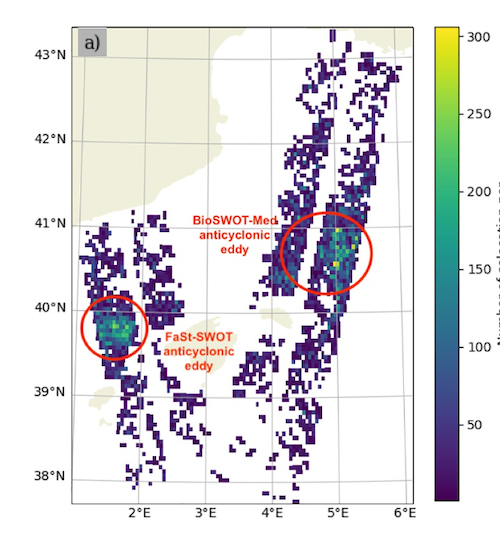
Disentangling noise and signal contributions in SWOT sea level data to improve surface current estimation. Drawing on fine-scale surface dynamics observed during a large drifter experiment in the Western Mediterranean Sea, a recent study assessed the quality of SWOT sea level measurements acquired during the 1-day repeat orbit phase. This work establishes a benchmark for extending SWOT sea level assessments to the global ocean.
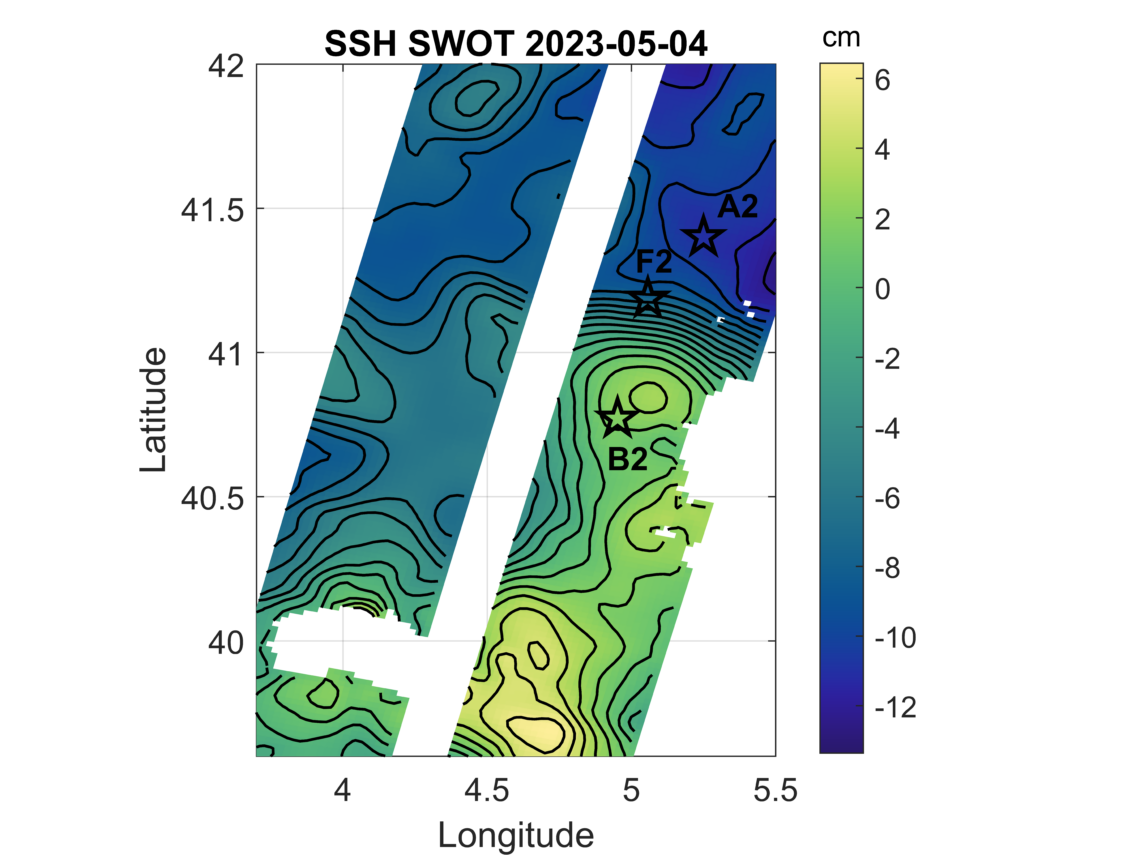
SWOT reveals that fine-scale eddies are as efficient as larger and more energetic structures in modulating turbulence in the ocean interior. Using data collected during the fast-sampling phase of the SWOT satellite, a study published on Journal of Geophysical Research: Oceans shows that fine-scale eddies (<100 km) in the Northwestern Mediterranean Sea are as efficient as large and intense structures found in western boundary currents and the Antarctic Circumpolar Current system in transferring wind energy into the ocean interior. These findings might apply to the rest of the global ocean characterized by low energy and thus provide a new challenge to parameterize this process in Earth system models.
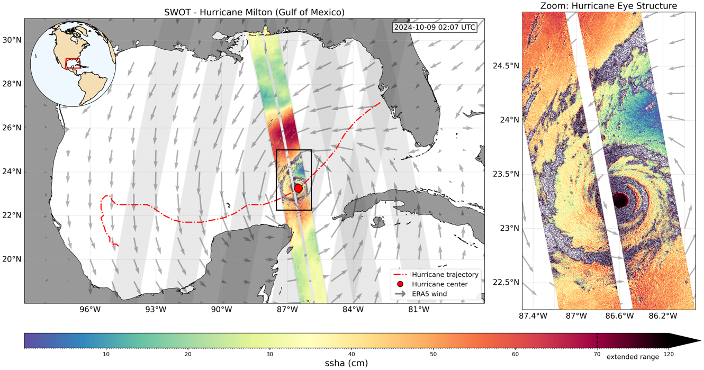
SWOT can map the spatial structure of storm surges across diverse oceanic regimes. An original study demonstrates the capability of SWOT to capture the spatial structure of storm surges during severe storms and hurricanes. A major advancement in coastal oceanography, SWOT hasstrong potential to improve scientific understanding, risk assessment, and long‐term coastal resilience.
All publications
| Year | Citation | DOI |
|---|---|---|
| in prep. | Barabinot et al. (2026), in prep. Drifters-SWOT analysis | |
| in prep. | Gómez-Navarro et al. (2026), in prep. SSH daily variability from glider and SWOT | |
| in prep. | López et al. (2026), in prep. HFR-SWOT comparison | |
| in prep. | Verger-Miralles et al. (2026), in prep. 3D reconstruction and vertical velocities | |
| preprint | Barabinot, Y., Lopez,G., Mourre, B. et al. Seasonality of surface turbulence in the Mediterranean Sea observed from space, 24 February 2026, PREPRINT (Version 1) available at Research Square | https://doi.org/10.21203/rs.3.rs-8960383/v1 |
| preprint | Demol et al. SWOT Sea-Level and Drifter Observations Reveal Ageostrophic Dynamics of Mesoscale Eddies in the Western Mediterranean | https://essopenarchive.org/doi/full/10.22541/essoar.15005044/v1 |
| prepring | Gómez-Navarro, L., Ballarotta, M., Cortés-Morales, D., Pujol, M.I., Fortunato, L., Mourre, B. and Pascual, A., 2025. New insights on mesoscale activity in the western Mediterranean Sea. State of the Planet Discussions, 2025, pp.1-22. | https://doi.org/10.5194/sp-2025-17 |
| preprint | Peng et al. Beyond the Surface: Synergistic Assimilation of SWOT and In-Situ Observations to Resolve a Small-scale Eddy (preprint, 2026) | https://doi.org/10.22541/essoar.15004530/v1 |
| preprint | Verger-Miralles et al. — A new open-source Python Toolbox for Oceanic Moving Vessel Profiler Data Processing · Earth and Space Science (preprint, 2026) | https://doi.org/10.22541/essoar.15002914/v1 |
| 2026 | Demol, M., Ponte, A. L., Garreau, P., Bellacicco, M., Berta, M., Centurioni, L. R., et al. (2026). Large drifter experiment in the Western Mediterranean Sea reveals dynamical versus noise contributions in SWOT-KaRIn sea level. Geophysical Research Letters, 53, e2025GL121425. | https://doi.org/10.1029/2025GL121425 |
| 2026 | Rolland, R., Bouruet-Aubertot, P., Cuypers, Y., Bosse, A., Petrenko, A., Maytie, T., et al. (2026). Near-inertial wave trapping inside a fine-scale anticyclonic eddy during the BioSWOT-Med 2023 cruise: Turbulence and energy flux. Journal of Geophysical Research: Oceans, 131, e2025JC022984. | https://doi.org/10.1029/2025JC022984 |
| 2025 | Fortunato, L., Gómez-Navarro, L., Combes, V., Cotroneo, Y., Aulicino, G., & Pascual, A. (2025). Coastal Eddy Detection in the Balearic Sea: SWOT Capabilities. Remote Sensing, 17(15), 2552. https://doi.org/10.3390/rs17152552 | https://doi.org/10.3390/rs17152552 |
| 2025 | Vega-Gimenez, D., Amores, A., Paris, A., & Pascual, A. (2025). Expanding the coastal observation frontier: SWOT reveals the spatial footprint of storm surges. Geophysical Research Letters, 52, e2025GL117299. | https://doi.org/10.1029/2025GL117299 |
| 2025 | Verger-Miralles, E., Mourre, B., Gómez‐Navarro, L., Barceló‐Llull, B., Casas, B., Cutolo, E., Díaz‐Barroso, L., d’Ovidio, F., Tarry, D.R., Zarokanellos, N.D. and Pascual, A., 2025. SWOT enhances small‐scale eddy detection in the Mediterranean Sea. Geophysical Research Letters, 52(16), p.e2025GL116480. | https://doi.org/10.1029/2025GL116480 |
| 2023 | Barceló-Llull B and Pascual A (2023) Recommendations for the design of in situ sampling strategies to reconstruct fine- scale ocean currents in the context of SWOT satellite mission. Front. Mar. Sci. 10: 1082978. | 10.3389/fmars.2023.1082978 |