The BioSWOT2025 meeting was the occasion to show first confirmed results from the BioSWOT-Med cruise that occurred in 2023 exploring the influence of ocean vortices, fronts, and filaments on marine biodiversity in the North West Mediterranean Sea.
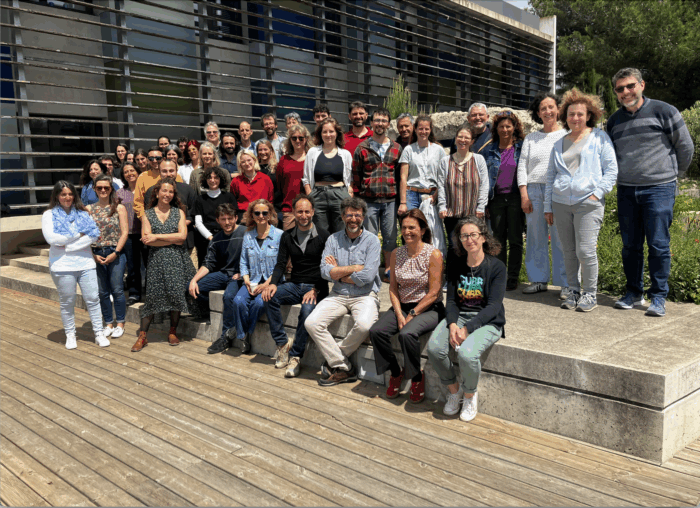
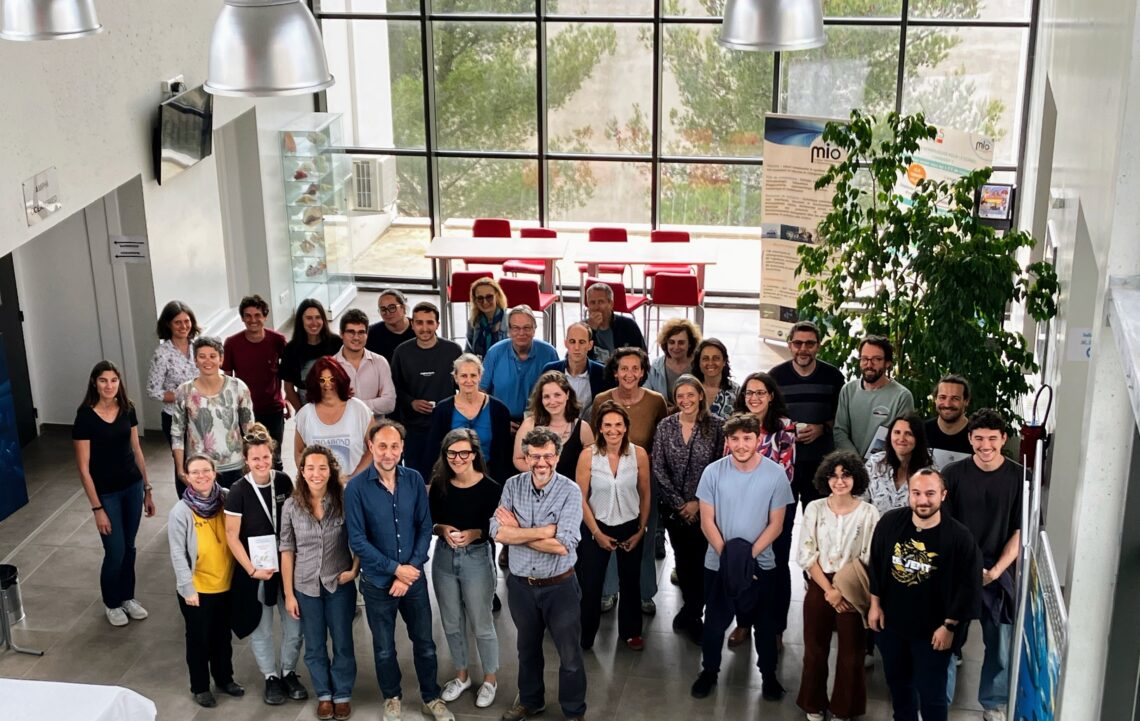
The BioSWOT Post-cruise and ANR Kick-Off meeting (BioSWOT2025) took place at the Mediterranean Institute of Oceanography (MIO), in Marseille, France, from 5 to 7 May. Over 45 researchers from France, Italy, New Zealand and the United States took part in the meeting, among them a large part of early career researchers.
The goal of BioSWOT2025 was to share the first results from analyses of data and samples gathered during the BioSWOT-Med cruise. This cruise explored a specific oceanic regime, the so-called “fine scales” (vortices, fronts, and filaments of 1-100km size) which are expected to have a primary role on marine life, yet are largely undocumented in many oceanic regions like the Mediterranean.
“This is an historical moment for exploring the ocean fine scales, with SWOT resolution being 10 times higher than what we had before”, commented Francesco d’Ovidio (LOCEAN-IPSL), PI of the BioSWOT ANR project and CNES Ocean Lead in the SWOT Science Team. Indeed, for the first time in history, high definition SSH data derived from SWOT satellite measurements were used to inform the adaptive sampling strategy employed during an oceanographic cruise, that targeted both physical and ecological processes, from nutrients’ concentration to top predators’ distribution, using a wide range of techniques, ranging from autonomous platforms to genomics. The comparison of SWOT maps and in situ observations was also the occasion to reflect on how the sampling strategy that was employed worked for detecting fine-scale oceanic features.
Over 30 talks were given during the three days of the meeting, and the researchers discussed which other collaborations or tools (e.g., modeling framework) are now needed to go further.
Trying to disentangle the processes at the base of physical dynamics and biological interactions
One of the main discussion topic research goals is to disentangle how different fine-scale processes have interacted together to produce the physical dynamics and the biological interactions observed across a front and an anticyclonic eddy encountered during the cruise in the North Balearic Sea. In this regard, Monique Messié (MBARI) illustrated the growth-advection method as a possible Lagrangian modeling approach to study plankton diversity.
Louise Rousselet (LOCEAN-IPSL) summarized the information necessary to inform a discussion on which biophysical landscapes are being unveiled thanks to the data acquired in BioSWOT-Med, while Magali Lescot (MIO) illustrated the large set of results acquired thanks to marine genomics. By applying omics (i.e., metabarcoding, metagenomics and metatranscriptomics) the goal is to investigate what is the impact of oceanic fine scales on plankton diversity. And in particular to investigate which species are present, what biological functions are present, and which functions were active during sampling in the different types of water masses sampled during the cruise. The study of omics is the subject of the BioSWOT ANR. How best we can use the incoming omics information (for which questions)?
Large participation of students and postdocs
One of the goals of the meeting was also to highlight the contribution to SWOT-related research carried out by students and early career researchers. Indeed, out of 30 presentations, 10 were given by students and post-doctoral researchers. Ludivine Grand and Lou Byrnes, both Masters’ students, presented, respectively, some preliminary results on fine scale distribution of ultraplankton and on a lagrangian study of fine-scale dynamics.
Among the PhD students, Aude Joel (MIO) discussed biogeochemical data on oceanic fine-scale circulation and nutriclines while Laurina Oms (MIO) presented results on contrasted phytoplankton communities along the front from flow cytometry. Camille Cardot presented a case study of mesoscale activity, comparing data derived from ocean currents derived from commercial ship positions and SWOT. The talk of Maxime Arnaud focused on vertical velocities from acoustics, while that of Maxime Duranson on fine scale zooplankton distribution.
Three postdoctoral researchers showed their results. Robin Rolland focused on eddy-wind interactions. Théo Garcia presented the statistical approach he used to unveil phytoplankton adaptation to oceanic fronts; while Alexandre Barboni compared estimations of geostrophic and ageostrophic velocities derived from SWOT and ADCP measurements and numerical simulations. Results from Emily Wagonner and Alba Filella focused on the distribution of organophosphate esters and polyphosphates.
Unexpected results and new research questions
Anthony Bosse (MIO) presented a fine-scale description of the anticyclone sampled during the BioSWOT-Med cruise, while Stéphanie Barillon (MIO) presented results with one of the only two systems so far existing for in situ measurements of vertical velocity. Maristella Berta (ISMAR-CNR) illustrated the reconstructed ageostrophic dynamics from drifter analysis, while Riccardo Martellucci (OGS) showed preliminary results on biophysical analyses from Argo floats. The presentation of Jean-Baptiste Roustan focused on preliminary results of the two-ships strategy during WEMSWOT/CSWOT cruises, performed just before BioSWOT-Med
Claude Estournel (LEGOS) and Valérie Garnier (IFREMER) compared results from Symphonie and Croco models with SWOT data while Mathilde Cancet showed how SWOT data can help understand the mechanisms of intrusions of the North Current on the shelf.
Sandra Nunige (MIO) gave a quick update on the large nutrients dataset she contributed to create, with both analyses onboard during the cruise (inorganic nutrients) and back in the laboratory. Dominique Lefevre (MIO) presented preliminary results on surface mapping of net community production, while the presentation of Marc Tedetti (MIO) focused on the distribution of CDOM and FDOM during the BioSWOT-Med cruise. Daniela Banaru (MIO) talked about phyto and zooplankton biomass, biochemical content and stable isotope ratios by size fraction.
Among the preliminary results presented during the meeting, there were also some unexpected results that gave rise to new research questions. For example, Alice della Penna (University of Auckland) analyses of an experiment she carried out in mesocosms while onboard the L’Atalante, to estimate the impact of diel vertical migration of mesozooplankton in surface communities of phytoplankton, suggested several competing hypotheses. The question also remains open on how the observed patterns might change in different water masses and on what is the role of patchiness in the ocean. On her side, Elvira Pulido (MIO) also showed some unexpected results on the availability of Phosphorus and the uptake of Dissolved Organic Matter by phytoplankton. Investigation of these new and competing hypotheses will require collaboration from the interdisciplinary BioSWOT-Med team.
Karine Leblanc (MIO) showed stunning images of nano and microplankton (electron microscopy) and described their distribution during the BioSWOT-Med cruise.
Contrasted ocean conditions possibly representative of other parts of the Mediterranean Sea?
The researchers were also interested in discussing how the physical mechanisms and the biological response encountered during the cruise are specific to the Mediterranean Sea and which ones may be typical of generically oligotrophic and moderately energetic conditions.
In this regard, the meeting closed with a keynote talk from Mark Ohman (SCRIPPS) that showed data collected south of Menorca and inside the anticyclonic eddy identified thanks to SWOT images north east of the Balearic Island by the Zooglider, a unique robotic autonomous instrument that dives to 400-meter depths and profiles the plankton using both imaging camera and active sonar as it ascends to the water column. The two regions differed for temperature, salinity, chlorophyll concentration and optical transparency. In parallel, plankton communities also differed.
Publications and new steps
The meeting had started on the first day with the distribution to all participants of the book “People, Science and instruments of the BioSWOT-Med campaign” created to give an overview of the scientific richness of an oceanographic campaign and to preserve the memory of the passion and dedication of the participants of the BioSWOT-Med project. It concluded on the third day with a general discussion on the scientific challenges ahead and the strategy to adopt to tell “the story of a front, an anticyclone and a storm”, the oceanographic features and meteorological conditions encountered during the BioSWOT-Med cruise.
“The progress of the analyses of the data collected during the campaign is satisfactory: we already have some confirmed results, which have been submitted for peer-review publication, and the preliminary results seen during these days are very encouraging and they will soon be presented in other conferences” said Andrea Doglioli (MIO), PI of the BioSWOT-Med cruise. “Furthermore, the outcome of this meeting foresees very promising future collaborations between colleagues who are highly motivated to continue the analysis and publish several articles” he concluded.
The next appointments to show results from the BioSWOT-Med experiment are at the SWOT Science Team Meeting in October in Archacon, France, and at the Ocean Sciences Meeting 2026 in Glasgow in February 2026.