The paper “SWOT and multi-platform observations enhance small-scale intrathermocline eddy detection” by Verger-Miralles et al. of the FaSt-SWOT team was submitted to Geophysical Research Letters. Here the key points from the research.
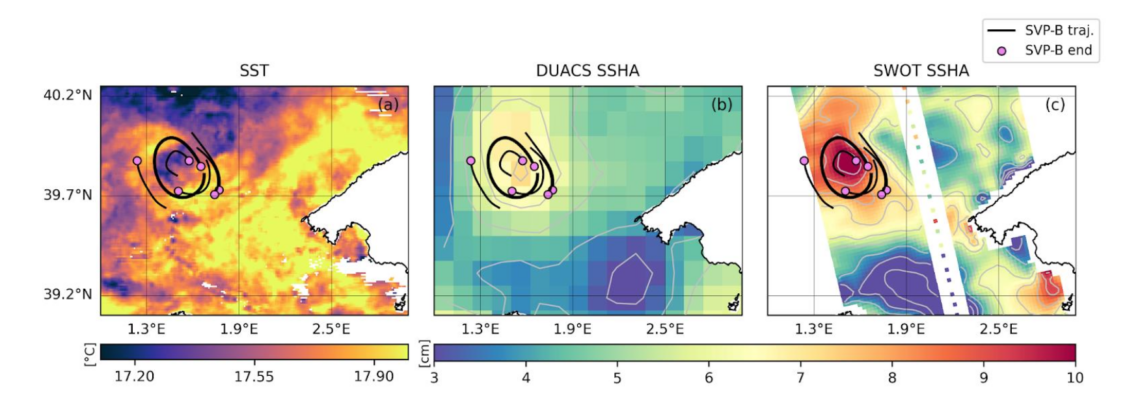
Ocean currents with spatial scales between 1 and 100 km are essential for regulating Earth’s climate by distributing heat, nutrients, and other properties within the oceans. The Surface Water and Ocean Topography (SWOT) satellite mission, launched in December 2022, offers a unique contribution to retrieve small-scale upper ocean dynamics, as it measures ocean surface heights at a resolution ten times finer than previous satellites. During its initial calibration phase, the FaSt-SWOT team conducted a multi-platform field experiment to evaluate the capability of SWOT to detect and measure a small subsurface (or intrathermocline) eddy in the Western Mediterranean Sea. The SWOT satellite successfully captured the sea level and ocean currents related to this eddy, showing significant accuracy improvements over traditional satellites compared to different in-situ instruments: a 33% better representation of sea level and an improvement in the magnitude of horizontal velocities between 44 and 61%. These results demonstrate SWOT’s capability to observe small-scale ocean dynamics.
Key Points:
The fast-sampling phase of the new SWOT satellite altimetry mission provides a unique opportunity to monitor small-scale ocean processes
SWOT accurately detects the signal of a ~20-25 km-radius intrathermocline eddy, as observed by multi-platform in-situ measurements
SWOT improves sea surface height estimation by ~30% and horizontal velocities by up to 61% compared to conventional altimetry
Read the full preprint:
Verger-Miralles, E., et al. SWOT and multi-platform observations enhance small-scale intrathermocline eddy detection. Submitted to Geophysical Research Letters. Preprint available at: https://essopenarchive.org/users/863652/articles/1245399-swot-enhances-small-scale-intrathermocline-eddy-detection. DOI: 10.22541/essoar.173315547.75973902/v1
Note: Preprints have not been peer reviewed. Data may be preliminary.