The BioSWOT-Med cruise (https://doi.org/10.17600/18002392) was the main study site for CNES during SWOT fast-sampling phase. Guided by early SWOT images, it located a fine-scale front in the northwestern Mediterranean Sea and adopted an adaptive Langrangian sampling strategy to gather an unprecedented high-resolution dataset of physical and biological variables across and within the front as well as in a nearby fine-scale eddy. The first four scientific papers from the cruise challenge assumptions about the physical and biological functioning of marine ecosystemsin low energy and low nutrient conditions. Results might apply to the other oligotrophic and moderately energetic regions of the global ocean and provide indication for future developments of earth system models and biogeochemical models.
An adaptive sampling strategy
The BioSWOT-Med cruise took place under track #3 of the SWOT satellite during its 1-day repeat orbit in the spring 2023. The main study site for CNES, this interdisciplinary campaign investigated the role of fine scales in shaping the structure and functioning of marine ecosystems from the physics, through plankton dynamics, and up to marine top predators.
An adaptive sampling strategy was implemented to investigate three distinct water masses across the North Balearic Front (Northwestern Mediterranean Sea). A relatively more productive water mass north of the front (referred to as ‘A’), a more oligotrophic and less productive one south of the front (‘B’), and the frontal zone itself (‘F’). Physical and biological parameters were collected and the occurrence of two storms during the cruise added to the interest of the study, allowing the BioSWOT-Med crew to explore the impact of strong wind events over fine-scale dynamics.
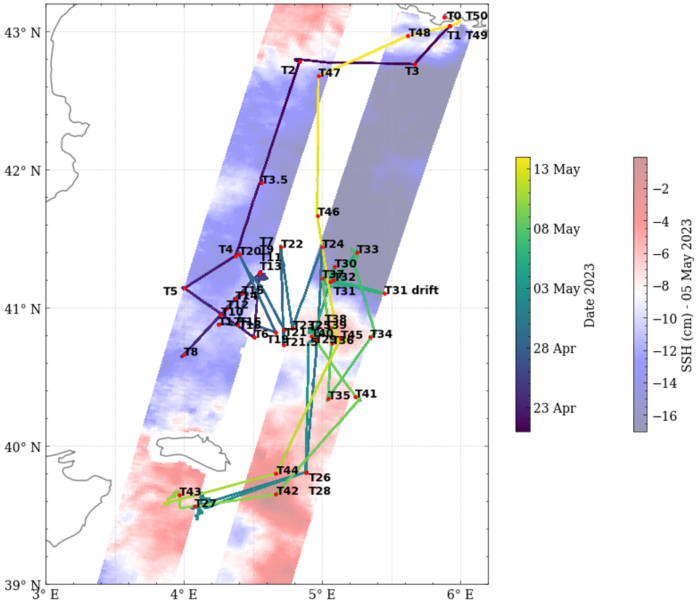
Map of the route of the BioSWOT-Med cruise. The route line is colored as a function of time and it is superposed to the SWOT pre-validated data. Credits: BioSWOT-Med cruise report.
Fine-scale eddies are as efficient as larger and more energetic structures in modulating turbulence in the ocean interior
The paper “Near-inertial wave trapping inside a fine-scale anticyclonic eddy during the BioSWOT-Med 2023 cruise: turbulence and energy flux” published on Journal of Geophysical Research: Oceans investigates how fine scales control the spatio-temporal variability of turbulence around the North Balearic Front.
The Balearic front separates a fine-scale anticyclonic eddy from a cyclonic area. Near-inertial waves are generated at large scale but are only trapped in the anticyclonic eddy. The front acts as a barrier for the near-inertial wave propagation. While the near-inertial waves propagate at depth into the eddy, they generate vertical shear that in turn leads to enhanced turbulence. On the other side of the front the absence of trapping (and then, of near-inertial wave propagation) explain the absence of turbulence enhancement.
The study found that fine-scale eddies are efficient for trapping near-inertial waves and driving vertical fluxes of energy below the mixed layer. In the past, this process of trapping has been observed in large anticyclonic eddies (ones that nadir altimetry could capture) or studied in idealized numerical studies. In principle, to be trapped, the near-inertial waves should be smaller than the anticyclonic eddy. The study shows that this process also occurs in smaller (fine-scale) anticyclonic eddy, for which the size of the near-inertial waves can be similar. Among previous observations of this process, only a few provided microstructure measurements, and even less provided vertical energy flux estimations, which are both important to quantify its effect on the mixing and the ocean energetics. The study provided both.
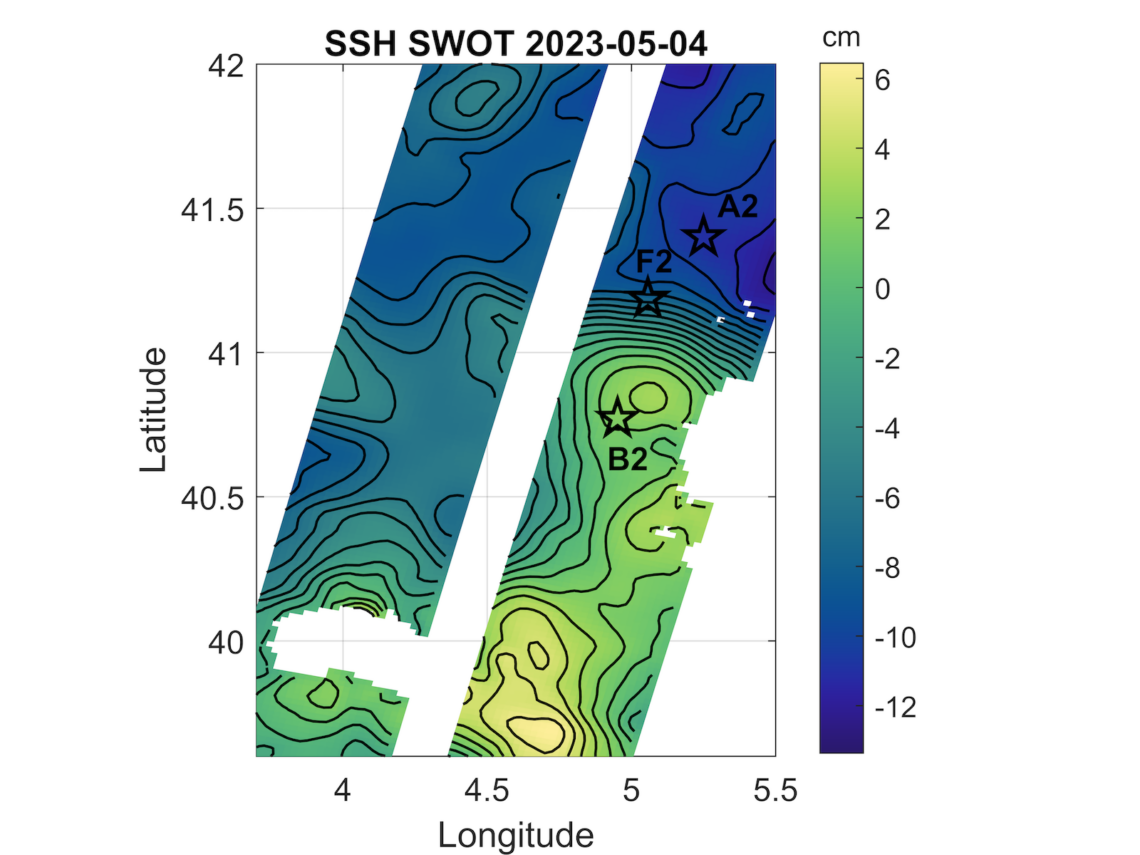
SWOT sea surface height measurements show an anticyclonic eddy that was not visible with nadir altimetry. SWOT data were acquired during stations B2 (located inside the anticyclonic eddy), station locations are indicated with black stars. Credits: Rolland et al. 2026
Eddies contribute to nutrient redistribution across distinct scales
The paper “Ocean Circulation Modulating the Nutrient Distribution and Fluxes at Regional and Fine scales: A Case Study in The Northwestern Mediterranean Sea” accepted in Geophysical Research Letter investigates the distribution of nutrients at fine scales across the North Balearic Front.
The Mediterranean Sea is considered one of the most oligotrophic region of the global ocean. Numerical models have consistently indicated that fine-scale processes play a significant role in shaping vertical nutrient distributions in oligotrophic regions. However, near-detection-limit surface nutrients concentration make resolving fine-scale biogeochemical variability challenging. For this reason, empirical validation of model signals has been limited by the scarcity of high-resolution, co-located, physical and biogeochemical observations.
During the BioSWOT-Med cruise, the combination of high-frequency vertical sampling, nanomolar phosphate detection, and B-spline interpolation provided robust estimates of nutrient distribution across and within the North Balearic Front, from regional to fine scales. This allowed to evaluate how local dynamics modulate vertical nutrient structures and to shed light on the coupled biogeochemical–physical processes that regulate new nutrient supply in oligotrophic environments.
Results suggest that the sampled eddy contributes to nutrient redistribution across distinct scales: within its core via enhanced turbulence, toward the oligotrophic waters south of the front through lateral isopycnal transport, and by increasing the effective permeability of the front, thereby facilitating south–north exchanges that may help sustain elevated biomass on its northern flank, particularly in post-bloom conditions.
Fine-scale fronts as a refuge for non-dominant phytoplankton groups
The paper “Fine-scale observations reveal distinct frontal phytoplankton communities” accepted for publication in Communications Earth & Environment, investigated changes in phytoplankton community composition across and within the North Balearic Front.
High-resolution underway data on phytoplankton biomass and community composition collected via flow cytometry across and within the North Balearic Front allowed the collection of an unprecedented high-resolution dataset.
Statistical analysis revealed that the phytoplankton community composition within the North Balearic Front (water mass F) differed significantly from that of surrounding waters (the more productive water mass A at the north and more oligotrophic and less productive water mass B south of the front). Specifically, while total phytoplankton biomass remained unchanged, the relative abundance of non-dominant groups increased within the frontal zone compared to water masses A and B.
These findings suggest that in moderately energetic, oligotrophic, conditions like those of the Mediterranean Sea, fronts do not drive surface biomass accumulation but instead restructure community composition by favoring less abundant groups. This contrasts with observations in more energetic regions of the global ocean, where fronts typically enhance total biomass.
These results underscore the role of fine-scale variability in maintaining community heterogeneity, suggesting that fronts may act as refuges for non-dominant phytoplankton groups in moderately energetic, oligotrophic conditions.
Fine-scales fronts as an ecological boundary for zooplankton
The paper “The North Balearic Front as an ecological boundary: zooplankton fine-scale distribution patterns in late spring” published in Biogeosciences presents the first detailed investigation of zooplankton distribution at fine scales in the North Balearic Front. Results from the study challenge general assumptions about the ecological role of oceanic fronts. In particular, the North Balearic Front exhibited characteristics more akin to a boundary between water masses than a zone of pronounced biological accumulation.
Oceanic fronts are often assumed to act as zones of biomass accumulation and enhanced productivity, but they can also function as ecological boundaries separating distinct communities. Results from the paper support the latter role, as zooplankton abundance was lowest at the North Balearic Front and community composition differed across it, particularly in surface layers. This challenges the general view of fronts as systematic biological hotspots.
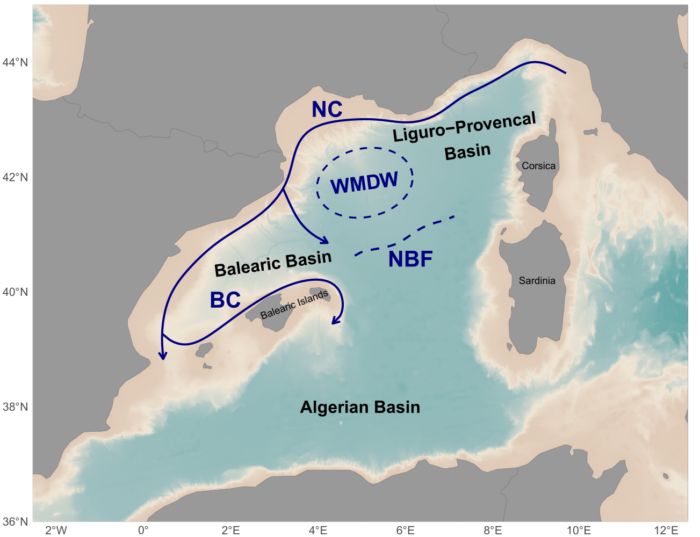
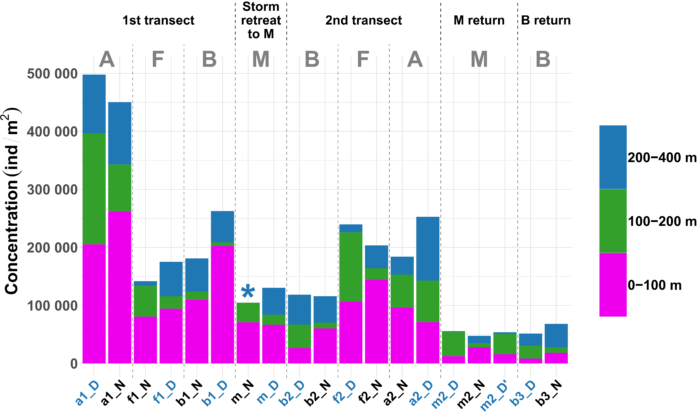
Map of the Northwestern Mediterranean Sea showing the major oceanographic features (left) and concentration of zooplankton at the sampling stations carried out during the BioSWOT-Med cruise (right). Credits: Duranson et al. 2025
New challenges for earth system models and biogeochemical models
Fine-scale structures are ubiquitous in the ocean and oligotrophic regions are projected to expand under climate change. The findings of the BioSWOT-Med cruise are likely to apply to other regions of the global ocean and suggest improvements in the parameterization of earth system models and biogeochemical models. For example:
- How to improve the parameterization of previously underestimated energy pathway connecting the ocean interior mediated by eddies with a radius of few tens km?
- What are the synergetic impacts of fine-scale circulation across larger spatial and temporal scale?
- Fine-scale physical features are important in determining the biogeography, the shape, and the structure of plankton communities. How to include these these dynamics into predictive biogeochemical models so to increase their ability to estimate changes in the functioning of marine ecosystems and of biogeochemistry under global change?
- How to include fine-scale dynamics in earth system models?
The BIOSWOT-Med project, supported by CNES and by ANR (ANR‐23‐CE01‐0027) is now continuing, focusing in particular on the exploitation of genomics data on phytoplankton communities collected during the cruise. These data are expected to provide further insights on the way in which fine scales impact the “patchiness” of phytoplankton functional types and taxa in the ocean.
Citations:
Duranson, M., Berline, L., Guilloux, L., Della Penna, A., Ohman, M.D., Gastauer, S., Cotte, C., Bănaru, D., Garcia, T., Berta, M. and Doglioli, A., 2026. The North Balearic Front as an ecological boundary: zooplankton fine-scale distribution patterns in late spring. Biogeosciences, 23(1), pp.363-385. https://doi.org/10.5194/bg-23-363-2026
Joël, A., Doglioli, A., Bosse, A., Bouruet-Aubertot, P., Buniak, L., Capet, X., d’Ovidio, F., Gregori, G.J., Martellucci, R., Mauri, E. and Menna, M., 2025. Ocean circulation modulating the nutricline at regional and fine scales: a case study in the Northwestern Mediterranean Sea. Authorea Preprints. DOI: 10.22541/au.176463275.55019718/v1
Oms, L., Doglioli, A., Messié, M., D’ovidio, F., Rousselet, L., Capet, X., Izard, L., Levy, M., Berta, M., Petrenko, A. and Bellacicco, M., 2025. “Living on the edge” Fine-scale observations reveal distinct frontal phytoplankton communities. Accepted for publication on Communications Earth & Environment. DOI : 10.21203/rs.3.rs-6412120/v1
Rolland, R., Bouruet-Aubertot, P., Cuypers, Y., Bosse, A., Petrenko, A., Maytie, T., et al. (2026). Near-inertial wave trapping inside a fine-scale anticyclonic eddy during the BioSWOT-Med 2023 cruise: Turbulence and energy flux. Journal of Geophysical Research: Oceans, 131, e2025JC022984. https://doi.org/10.1029/2025JC022984