In situ images collected by an autonomous Zooglider during the BioSWOT-Med cruise in the northwestern Mediterranean Sea revealed “giant” phytoplankton: undisturbed chains of diatoms and other phytoplankton about an order of magnitude longer than what typically expected. These elongated chains are largely inaccessible to planktonic grazers and have the potential to sink rapidly through the ocean water column.
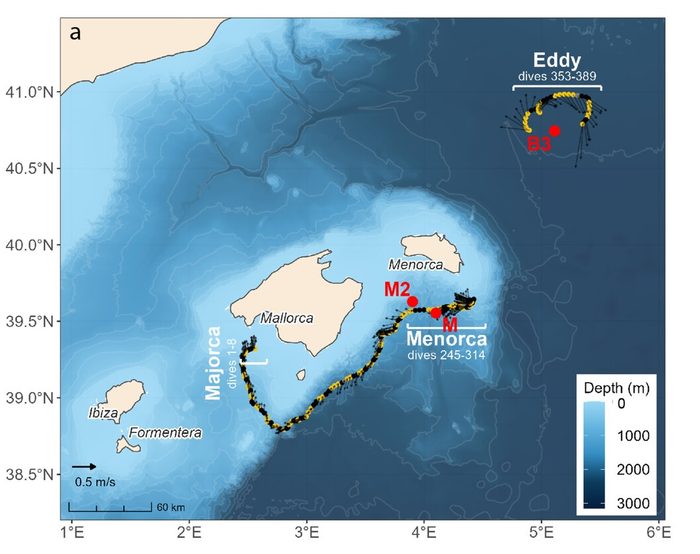
Zooglider trajectory in the northwestern Mediterranean Sea in conjunction with the BioSWOT-Med cruise, March 30–May 8, 2023. Zooglider track with dive numbers indicating dives when Zoocam, the Zooglider’s imaging system, was activated in three regions. Letters M, M2, and B3 indicate shipboard water column sampling locations. Fig. 1 from Ohman et al. (2026), CC BY 4.0. Adapted.
The size distribution of diatoms and other phytoplankton influences their accessibility to planktonic grazers, sinking velocities, and contributions to vertical export of carbon and nutrients. However, conventional methods to study phytoplankton remove them from ocean and lakes for measurement, often disrupting fragile chains and altering their natural morphology.
During the BioSWOT-Med cruise the deployment of an autonomous Zooglider equipped with a flow-through imaging system, an underwater camera that images the water passing through it, allowed researchers to acquire in situ images that were used to characterize undisturbed phytoplankton while suspended in their natural environment. Results of this characterization are reported on the paper Giant phytoplankton revealed by in situ imaging published on Limnology and Oceanography Letters.
The analysis of the images uncovered surprisingly long chains of diatoms (genus Guinardia, Proboscia, and others) and solitary filaments of the cyanobacterium Trichodesmium that attained lengths of 6.4–10.4 mm. The researchers defined them as “giant” phytoplankton because their chains of extraordinary size exceed by an order of magnitude the general expectation of chains smaller than 200 μm.
The longest in situ imaged chains were consistently longer than corresponding types of phytoplankton collected independently by vertical phytoplankton net hauls carried out during BioSWOT-Med and analyzed by microscopy.
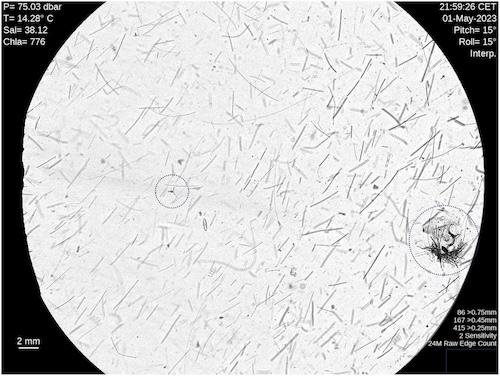
Image taken by the Zoocam, the underwater camera mounted on the Zooglider, taken at about 75 m depth, showing numerous elongate phytoplankton chains. Common zooplankton groups (the copepod Oithona, left, and the appendicularian Oikopleura sp., right) are indicated in circles. The image shows their mucus-house incurrent filters clogged with diatom chains. Fig. 4, Ohman et al. (2026), CC BY 4.0. Adapted.
Accurate representation of the size composition of cells and chains is important for diverse issues in aquatic ecology. Indeed, interactions among phytoplankton and zooplankton that feed on them are often described as size-dependent, with zooplankton ingesting a limited part of the size spectrum of available phytoplankton cells.
The elongated chains revealed by in situ images are largely inaccessible to most zooplankton, including copepods and appendicularians, and have the potential to sink rapidly through the ocean water column.
While most elongate chains imaged by Zooglider during the BioSWOT-Med cruise were distributed in the upper 100 m of the water column, overlapping the deep chlorophyll maximum, some were found as deep as 400 m, suggesting occasional export into deep waters. These deepest chains were detected in an anticyclonic eddy where vertical velocities of the fluid could further facilitate downward displacement and concentration.
The study suggests that these type of giant phytoplankton chains might be widely distributed in the ocean, but their detection requires noninvasive measurement methods that do not disrupt the fluid environment or disturb suspended phytoplankton.
These elongated chains are largely inaccessible to planktonic grazers and have the potential to sink rapidly through the ocean water column, thus impacting vertical transport of carbon and nutrients.
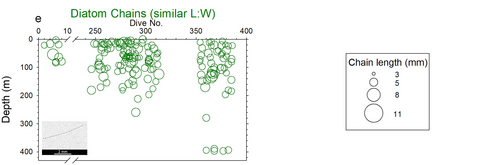
Depth distribution of diatom chains with a similar length : width ratio of individual cells along the Zooglider trajectory. Chains were found down to 400 m. The diameter of each circle is proportional to chain length (in millimeters). Fig. 3e, Ohman et al. (2026), CC BY 4.0. Adapted.
Citation: Ohman, M.D., Leblanc, K., Ellen, J.S. and Gastauer, S. (2026), Giant phytoplankton revealed by in situ imaging. Limnol. Oceanogr. Lett., 11: e70163. https://doi.org/10.1002/lol2.70163
Contact: Mark H. Ohman,