The first detailed investigation of zooplankton distribution at fine scales in the North Balearic Front has been published in Biogeosciences. The work was carried out during the BioSWOT-Med cruise under the coordination of François Carlotti. François, who passed away earlier this January, has been a pioneer in the study of zooplankton from the polar oceans to the Mediterranean Sea.
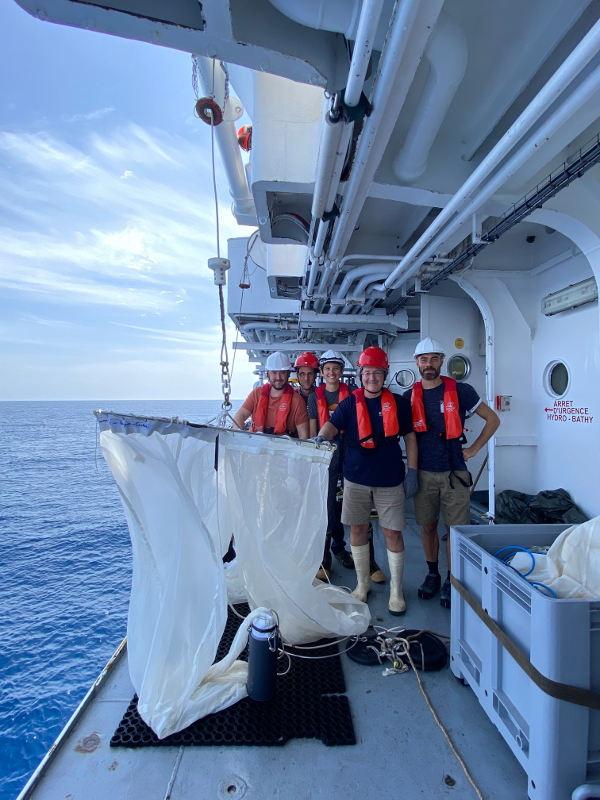
François Carlotti (front, with red helmet and white boots) and the “Zooplankton Busters” during the BioSWOT-Med cruise.
The paper “The North Balearic Front as an ecological boundary: zooplankton fine-scale distribution patterns in late spring” published in Biogeosciences presents the first detailed investigation of zooplankton distribution at fine scales in the North Balearic Front. Results from the study challenge general assumptions about the ecological role of oceanic fronts. In particular, the North Balearic Front exhibited characteristics more akin to a boundary between water masses than a zone of pronounced biological accumulation.
The North Balearic Front is one of the most pronounced geostrophic frontal zones in the Northwestern Mediterranean Sea and separates water masses of the Provencal Basin to the north and the Algerian Basin to the south. Data were collected during the BioSWOT-Med cruise in spring 2023. During the cruise, an adaptive multidisciplinary sampling approach was applied, using information provided by daily SWOT images available during the SWOT 1 day repeat orbit.
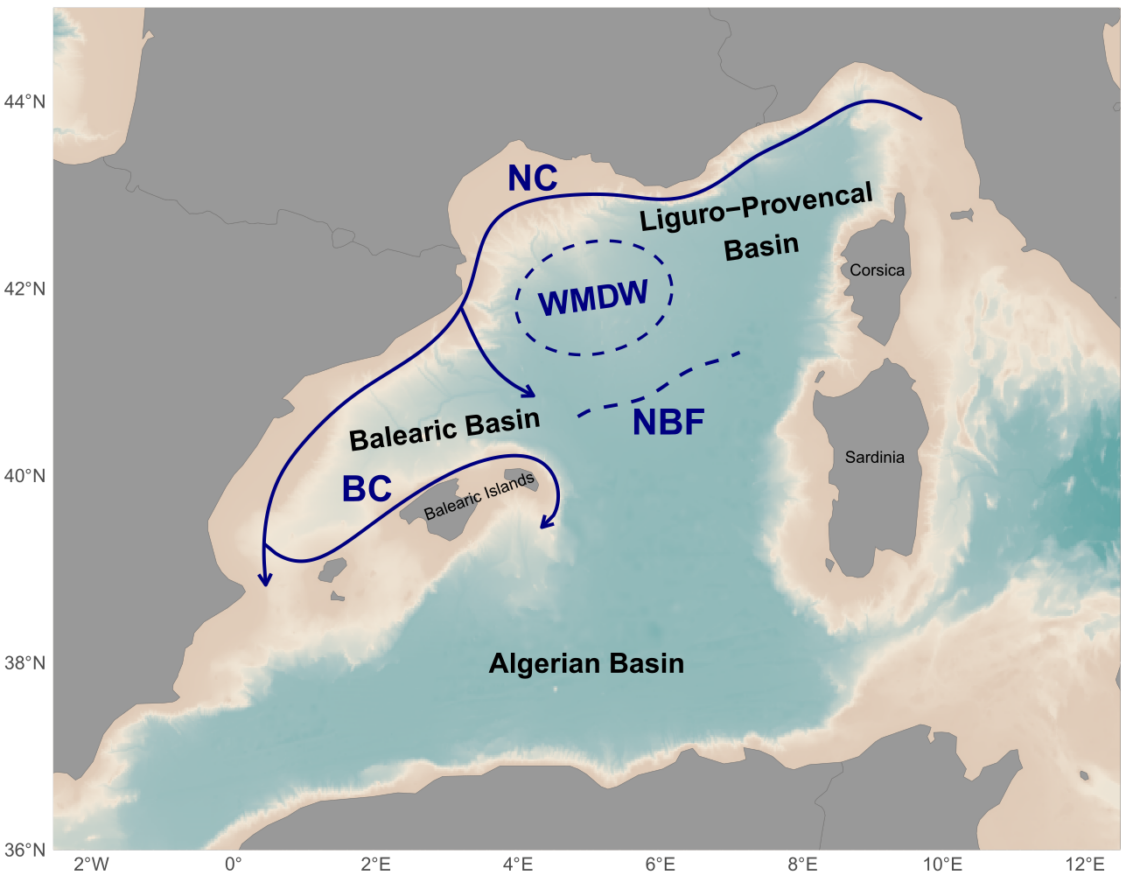
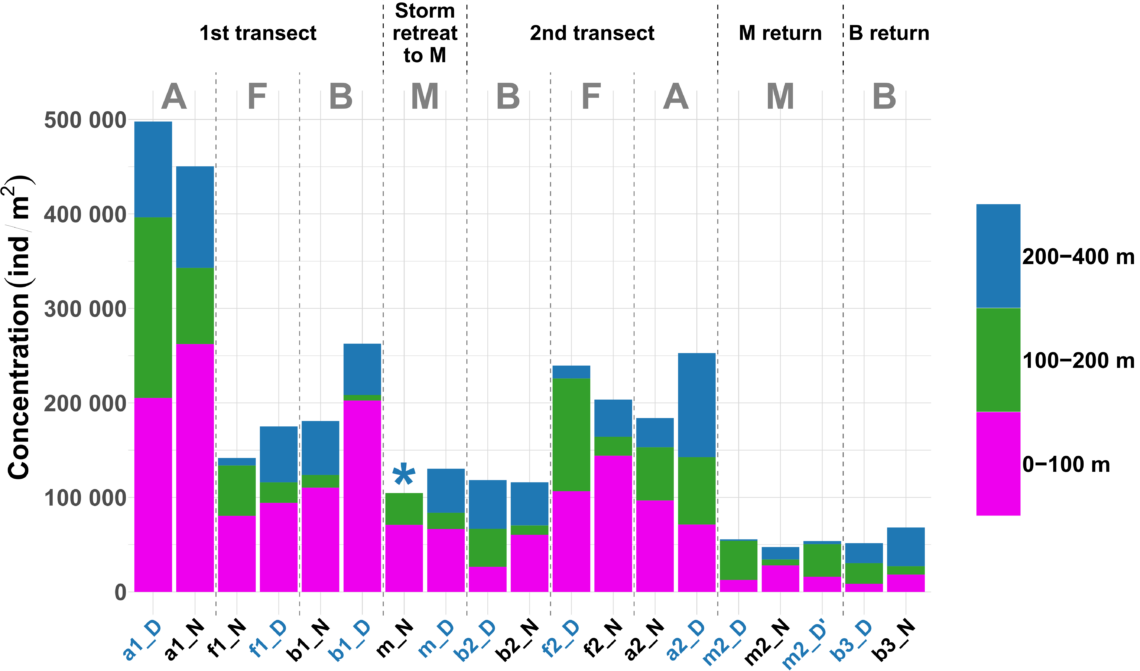
Map of the Northwestern Mediterranean Sea showing the major oceanographic features (left) and concentration of zooplankton at the sampling stations carried out during the BioSWOT-Med cruise (right). From Duranson et al. in press
Challenging assumptions about the ecological role of fronts in the ocean
Results from the study challenge some general assumptions about the ecological role of fronts in the ocean. “Oceanic fronts are often assumed to act as zones of biomass accumulation and enhanced productivity, but they can also function as ecological boundaries separating distinct communities. Our results support the latter role, as zooplankton abundance was lowest at the North Balearic Front and community composition differed across it, particularly in surface layers. This challenges the general view of fronts as systematic biological hotspots” says Maxime Duranson, first author of the paper and PhD student at the Thünen Institute of Sea Fisheries, Bremerhaven, Germany.
Another key question of the study was whether the front hosted a distinct zooplankton community or represented a mixture of communities from adjacent water masses. “This could not be fully resolved because a storm during the cruise likely disrupted the frontal structure, and blurred fine-scale biological patterns, limiting our ability to detect stable community signatures at the front” says Duranson.
The work was supported by French spatial agency Centre Nationales Etudes Centre National d’Etudes Spatiales (CNES) and is a contribution to the CNES-funded BioSWOT-AdaC project and by the ANR-FRANCE (French National Research Agency) and is a contribution to the BIOSWOT ANR-23-CE01-0027 project.
A legacy of François Carlotti
The study of zooplankton communities in the BioSWOT-Med cruise was carried out under the coordination of François Carlotti, CNRS researcher and director of research at the Mediterranean Institute of Oceanography, in Marseille, France.
François, who passed away earlier this January, has been a pioneer in the study of zooplankton, from the polar oceans to the tropics and the Mediterranean Sea, including both the open ocean and the coastal domain. His research interests included the importance of coupling between hydrodynamic processes, their biogeochemical consequences, and the behavior of organisms. He was known for his leadership in developing quantitative models of zooplankton population dynamics, as well as the contribution of zooplankton to trophic interactions and biogeochemical fluxes in ocean ecosystems.
François was a hard-working and enthusiastic colleague and a fun person. His friendship, as well as his curiosity and analytical mind were very appreciated.
Senior researchers and early careers likewise remember with pleasure the time spent doing research and sharing life with him aboard L’Atalante during the BioSWOT-Med cruise. All colleagues strongly admired François’ commitment to developing strong science while testing new methods, sharing knowledge and enjoying life: he was always engaged more than 100% in everything!
The BioSWOT-Med blog | Interview to François Carlotti during the BioSWOT-Med cruise
