Comparing SWOT measurements with mooring observations during the 1-day repeat orbit in a region where internal gravity waves (IGWs) are particularly strong, a new study demonstrates SWOT’s ability to accurately capture the sea surface height signature of high-frequency internal waves at the centimeter level. It provides a benchmark for future studies aiming to characterize internal waves from SWOT measurements across the global ocean, while highlighting the need for improved methods to separate the contributions of ocean currents and wave-like motions where in situ data are not available.

View south from Île des Pines, New Caledonia, where energetic internal tides are produced over the seafloor just tens of kilometers offshore and where the SWOTALIS field campaign took place during SWOT’s 1-day repeat orbit. Credits: Arne Bendinger.
The SWOT satellite reveals fine-scale ocean dynamics, including fast-moving internal waves called internal gravity waves (IGWs). This opens up the possibility to study IGWs’ dynamics and how they interact with background large scale currents. But this new capability brings a challenge: in regions where internal gravity waves are energetic, they produce sea surface height variations of similar size to those produced by currents, eddies and fronts. Using SWOT measurements from these regions therefore requires disentangling the two signals.
The paper Assessing dynamical contributions to SWOT sea surface height in an internal tide hotspot published in Geophysical Research Letters compared sea surface height anomalies (SSHA) measured by the SWOT satellite during its 1-day repeat orbit with SSHA estimated from in situ temperature and pressure sensors mounted on mooring lines that were deployed in the framework of the SWOTALIS field campaign south of New Caledonia in the southwestern tropical Pacific. This region is well-known for hosting very energetic IGWs at tidal frequencies called internal tides.
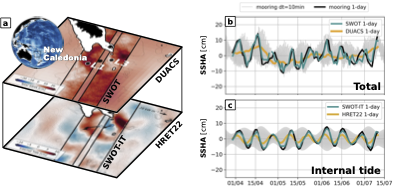
Figure 1. The study region south of New Caledonia in the southwestern tropical Pacific with the three moorings (L1, L2, L3) deployed during SWOT’s 1-day repeat orbit showing a snapshot from (a) total SSHA from SWOT with DUACS in the background and corresponding internal tide signature derived from SWOT (SWOT-IT) with HRET22 in the background. (b) Time series of mooring-derived total SSHA at full temporal resolution (dt=10 min; gray), subsampled to the near-daily SWOT Cal/Val sampling (black), and compared with SSHA from SWOT (green) and DUACS (yellow) shown for mooring location L1. (c) same as in (b) but for the coherent semidiurnal internal tide in comparison with estimates from SWOT‐IT (green) and HRET22 (yellow). Credits: Bendinger et al. (2026).
The importance of including baroclinic pressure anomalies at the ocean bottom
In a stratified ocean, water density varies with depth because of changes in temperature and salinity. Baroclinic motion in the ocean (e.g. mesoscale eddies and internal tides) is associated with the upward and downward displacements of these density layers. As density layers are displaced, they generate pressure variations throughout the water column, including at the ocean bottom. These pressure variations are referred to as baroclinic pressure anomalies.
Sea level measurements by satellites reflect the vertically integrated effect of the ocean’s pressure fields. Sea level reconstructions based on in situ measurements often do not account for baroclinic pressure anomalies at the ocean bottom due to missing bottom pressure observations. However, the study showed that their inclusion is essential to correctly reconstruct sea surface height in locations where IGWs are very energetic.
“Standard mooring configurations are typically designed to resolve variability in the upper ocean. Even when moorings extend through most of the water column, measurements close to the seafloor are often sparse or absent. For large-scale ocean circulation, the contribution of baroclinic bottom pressure to sea level variability is often small. However, it becomes important when studying motions associated with superinertial frequencies, meaning frequencies higher than the local Coriolis frequency (corresponding to periods shorter than about 30 hours at our study site). Such motions often include internal waves, which exhibit a measurable pressure signal at the bottom” says Arne Bendinger, researcher at LOPS and first author of the study.
“Our study site is dominated by internal tides, internal waves at tidal frequency generated when tidal currents interact with the sloping seafloor such as continental slopes, mid-ocean ridges, and seamounts. Thus, baroclinic pressure anomalies at the ocean bottom, obtained from high-accuracy bottom pressure sensors deployed as close to the mooring deployment location as possible, are indispensable to reconstruct sea level variability in this region for comparison with SWOT” says Bendinger.
The information retrieved with the moorings was used to assess the accuracy of internal tides derived from SWOT measurements. “Conventional nadir-only satellites rely on harmonic analysis to extract the internal tide signal but this method is limited due to their coarse sampling in space and time. Wide-swath observations from SWOT offer new methodologies and opportunities. Here, we used an established statistical approach based on Principal Component Analysis (PCA), previously applied on SWOT observations off the Amazonian Shelf (Tchilibou et al., 2025). PCA is particularly suited for our purpose since it identifies the internal tide’s repetitive and persistent nature over the course of SWOT’s Cal/Val phase. By doing so, we can directly infer the internal tide signal from SWOT swaths. The retrieved internal tide signal shows very good agreement with the signal derived from mooring observations, giving us confidence in both SWOT’s ability to accurately capture the internal tide and the PCA to extract such signal” says Bendinger.
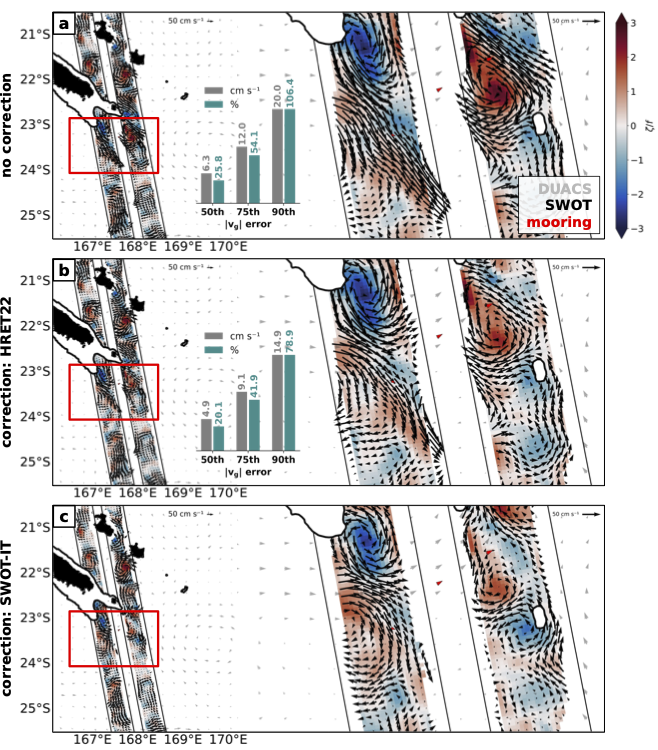
Figure 2. Snapshots illustrating the effect how SWOT‐derived velocity and relative vorticity fields are biased when not properly correcting SWOT SSHA for the surface signature of internal tides: (a) not correcting for internal tides, (b) correcting for internal tides using HRET22, and (c) correcting for internal tides inferred from SWOT (SWOT‐IT). The realism of SWOT‐derived velocities, with and without internal tide correction, is qualitatively assessed using mooring‐derived velocities (red vectors). DUACS‐derived velocities are also shown (gray vectors). A zoomed view of the swaths is shown in each case. Insets in panels (a) and (b) show absolute (gray) and relative (green) velocity errors relative to SWOT‐IT at the 50th, 75th, and 90th percentiles along the SWOT swaths (pass 4) in the region encompassing New Caledonia during the Cal/Val period. Credits: Bendinger et al. (2026).
Relevance to society
When reconstructing ocean circulation using satellite measurements of sea level height in regions of the global ocean where wave-like motions explain a substantial fraction of sea surface height variability, it is important to be able to separate their contribution to sea surface height from the contribution that is due to ocean currents.
“Sea level measurements from SWOT transform our view of the ocean by observing sea level variations at scales that were previously inaccessible to conventional altimetry. These observations are expected to improve our understanding of how energy, heat, carbon, nutrients, and other tracers are transported within the ocean and exchanged with the atmosphere and how associated processes regulate Earth’s climate and marine ecosystems.
At these newly resolved scales, however, sea level measurements contain signals from fundamentally different types of ocean motions. Some are associated with ocean circulation, including currents, eddies, and fronts, which transport material. Others are associated with internal gravity waves, including internal tides, which do not have a net effect on transport. Because these processes can occur at similar spatial and temporal scales and produce sea surface height variations of comparable magnitude, disentangling them is a major challenge” explains Bendinger.
The study demonstrates that SWOT can accurately capture the sea level signature of internal tides. By validating SWOT observations against mooring measurements, the study provides a benchmark for future studies seeking to characterize internal waves from SWOT observations across the global ocean. “This opens new opportunities to investigate how internal waves propagate, interact with ocean currents, and transfer energy through the ocean interior. In turn, the ocean circulation, free of internal wave dynamics, would be better captured, and would lead to improved transport patterns. At the same time, our results highlight the importance of separating circulation- and wave-driven variability in SWOT measurements. If the sea level signal associated with internal waves is incorrectly interpreted as ocean circulation, estimates of currents, eddies, and fronts may be biased. Telling waves and currents apart is therefore essential for using SWOT to study ocean circulation and variability” concludes Bendinger.
Citation: Bendinger, A., Vic, C., Tchilibou, M., Cravatte, S., & Gourdeau, L. (2026). Assessing dynamical contributions to SWOT sea surface height in an internal tide hotspot. Geophysical Research Letters, 53, e2026GL123239. https://doi.org/10.1029/2026GL123239
Contact: Arne Bendinger ()