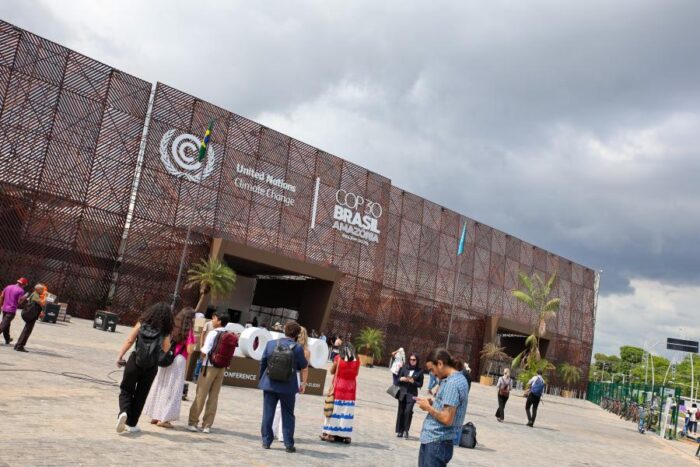
The contribution of the SWOT mission to the observation of the ocean and the cryosphere, as well as its potential support to climate education, ocean literacy, and the promotion of space science, were presented during a side-event at COP30, in Belém, Brazil.
[Article first published on AVISO]
In the framework of a collaboration between CNES and the Office for Climate Education (OCE) the Surface Water and Ocean Topography (SWOT) mission was presented on Monday, November 17, at the COP30 Cryosphere Pavilion in Belém during the panel “Educating for the Cryosphere: 5 years of lessons learned and future pathways for impact”.
Eric Guilyardi, oceanographer (CNRS, LOCEAN-IPSL) and President of the Office for Climate Education (OCE), highlighted how the SWOT project represents a major advance in the observation of the ocean and the cryosphere.
Beyond its scientific implications, the SWOT projects opens up significant opportunities for collaboration between the scientific and educational communities, providing fertile ground for climate education, ocean literacy, and the promotion of space science.
Eric Guilyardi also emphasized how data acquired by SWOT will be used to enrich the next edition of the teacher’s manual “Ocean and Cryosphere: The Climate in Our Hands” developed by OCE for primary and secondary educators.
Published in 2019, this handbook offers teachers a ready-to-use curriculum enabling them to study the role of oceans in climate regulation, the ecosystem services provided by oceans and the cryosphere, and the effects of climate change on oceans. The activities emphasize investigative approaches and project-based learning. This teaching guide has been published in four languages and adapted for local use in Latin America, Africa, and Asia. It has been implemented by more than 10,000 teachers worldwide, reaching nearly 400,000 students.
The new version of the handbook, supported by many partners including CNES, will showcase a new section on ocean observation, highlighting space-borne observation and the contributions of the SWOT mission.
The other panelists were Djian Sadadou, Head of International Relations and Communities – Office for Climate Education, International; Narissa Bax, Marine Scientist at Pinngortitaleriffik Greenland Institute of Natural Resources, Nuuk; Ignacio Orellanos, Programs Coordinator, 1.5 Chile. The discussion of the panel focused on the issues linking the ocean, the cryosphere, and education in Latin America.
The SWOT mission is a global survey of Earth’s surface water and is carried out by the Centre National d’Etudes Spatiales (CNES) and NASA, with contributions from the Canadian Space Agency (CSA) and the United Kingdom Space Agency.
Launched in December 2022, the SWOT satellite uses state-of-the-art radar interferometry technology to measure the elevation of water, and observes major lakes, rivers and wetlands while detecting ocean features with unprecedented resolution. SWOT data are providing critical information that is needed to assess water resources on land, track regional sea level changes, monitor coastal processes, and observe fine scale ocean currents and eddies.
The SWOT Science Team has researchers from around the globe with expertise in oceanography and hydrology. This multidisciplinary group is tackling pressing issues such as availability of Earth’s freshwater resources, our changing ocean and coasts,the cryosphere, and much more. Besides providing a fascinating exploration of our planet, their studies will contribute achieving societal goals of clean air and water, preparedness for extreme events, and adaptation to long-term environmental changes on continental scales.