The merging of anticyclonic eddy with the Lofoten Vortex was observed by an autonomous ocean glider and by SWOT satellite during the 1-day repeat orbit.
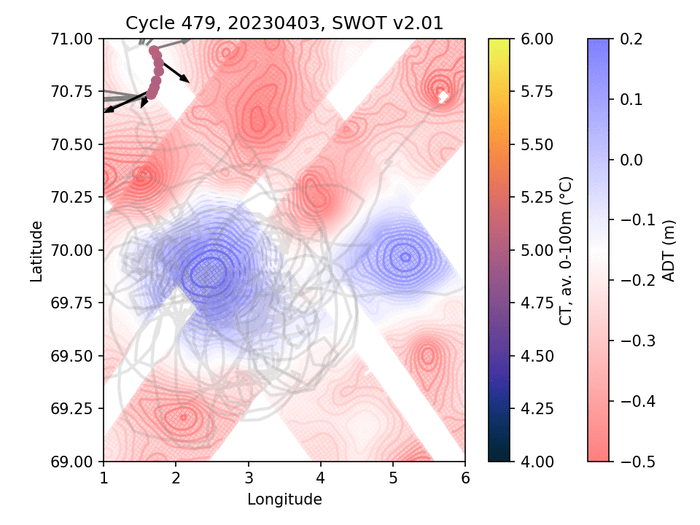
The Lofoten basin contains relatively warm waters, for this latitude. It is the largest oceanic reservoir of heat in the Nordic Seas. Warm Atlantic water enters the Basin either from the south from the Norwegian Atlantic Current, or from the east via anticyclonic mesoscale eddies shed from the Norwegian Atlantic Slope Current near the Lofoten Escarpment. In this basin, the Lofoten Vortex is an intense anticyclonic eddy permanently present in the Basin at its deepest (3250 m; note that it is not the fabled Maelstrom). One of the hypothesis on the maintained heat and salt at this location is that anticyclonic eddies in the Lofoten Basin shed from the eastern branch of the Norwegian Atlantic Current merge with the Lofoten Vortex. However, the mechanism is hard to observe directly due to its transient and unpredictable nature.
During the SWOT CalVal phase such a merging was observed from both in-situ data from an autonomous ocean glider, and absolute dynamic topography (and derived velocities) from SWOT, with a cross-over just over the area. The fact that SWOT measurements were available twice a day enabled to monitor the whole merging process quite closely with an unprecedented temporal resolution. During the observed process, a smaller incoming eddy gradually approaches the Lofoten Vortex, and then elongates as the two begin to rotate jointly and then merge, with consequences on vorticity and eddy kinetic energy. The glider data corroborated the SWOT observations, and informed on what was happening at depth during the merging process. The frequency and impact of such events are however to be detailed by more studies and observations. Such phenomena provide insights into ocean vertical mixing and heat transport.
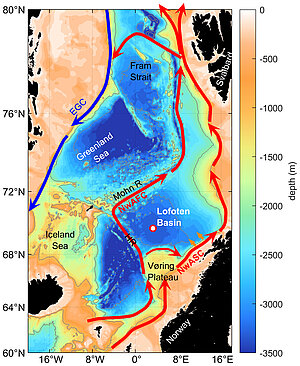
The Nordic Seas. Bathymetry is shown in colour, with grey contour lines every 1000 m. The coloured arrows represent the main circulation patterns, with the warm Norwegian Atlantic Current in red and the cold East Greenland Current (EGC) in blue. Small orange arrows indicate the region where warm anticyclonic eddies are shed from the NwASC. HR denotes the Helgeland Ridge, Mohn R denotes the Mohn Ridge, NwAFC denotes the Norwegian Atlantic Front Current, and NwASC denotes the Norwegian Atlantic Slope Current. The white circle with the red outline in the Lofoten Basin marks the mean position of the Lofoten Vortex. (from [Damerell et al., 2026])
Citation: Damerell, G. M., Bosse, A., and Fer, I.: Merging of a mesoscale eddy into the Lofoten Vortex in the Norwegian Sea captured by an ocean glider and SWOT observations, Ocean Sci., 21, 2763–2785, https://doi.org/10.5194/os-21-2763-2025, 2025 .
Article first appeared on AVISO