A study published on Geophysical Research Letters shows that in the North Western Mediterranean Sea, fine-scale eddies can contribute to redistribution of nutrients across distinct scales, first by their accumulation deep inside the eddy and then through lateral diffusion outside it. With climate change, the oligotrophic conditions typical of the Mediterranean Sea are expected to expand in the global ocean and results from this work represents an important contribution in understanding the evolution of biogeochemical processes in the future.
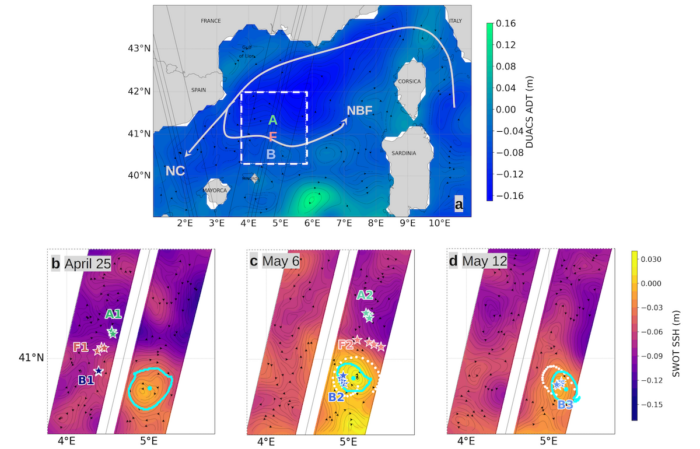
Study site of the BioSWOT-Med cruise with the frontal zone (F) and distinct water masses (A and B). Bottom: Sea surface height from SWOT satellite, eddy location. Credits: Joël et al. 2026
The paper “Ocean Circulation Modulating the Nutrient Distribution and Fluxes at Regional and Fine scales: A Case Study in The Northwestern Mediterranean Sea” published in Geophysical Research Letter investigates the role of fine-scale eddies in the distribution of nutrients across multiple scales at the North Balearic Frontal zone.
The Mediterranean Sea is one of the most oligotrophic regions of the global ocean. Numerical models have consistently indicated that fine-scale processes play a significant role in shaping vertical nutrient distributions in oligotrophic regions. However, near-detection-limit surface nutrients concentration make resolving fine-scale biogeochemical variability challenging. For this reason, empirical validation of model signals has been limited by the scarcity of high-resolution, co-located, physical and biogeochemical observations.
During the BioSWOT-Med cruise, near-real time data of sea surface height from the SWOT satellite guided the identification of a fine-scale frontal area. Here, the combination of high-frequency vertical sampling, nanomolar phosphate detection, and B-spline interpolation provided robust estimates of nutrient distribution across and within the North Balearic Front, from regional to fine scales. This dataset allowed to evaluate how local dynamics modulate vertical nutrient structures and to shed light on the coupled biogeochemical–physical processes that regulate new nutrient supply in oligotrophic environments. In situ data allowed to study for the first time the lateral transport of nutrients at fine scales.
Fine-scale circulation modulates nutrient distribution across distinct scales
Results showed that distinct water masses were characterized by different nutrient availability, suggesting that fine-scale circulation modulates nutrient distribution. Results also showed that the sampled eddy contributed to nutrient redistribution across distinct scales: within its core via enhanced turbulence, toward the oligotrophic waters south of the front through lateral isopycnal transport, and by increasing the effective permeability of the front, thereby facilitating south–north exchanges that may help sustain elevated biomass on its northern flank, particularly in post-bloom conditions.
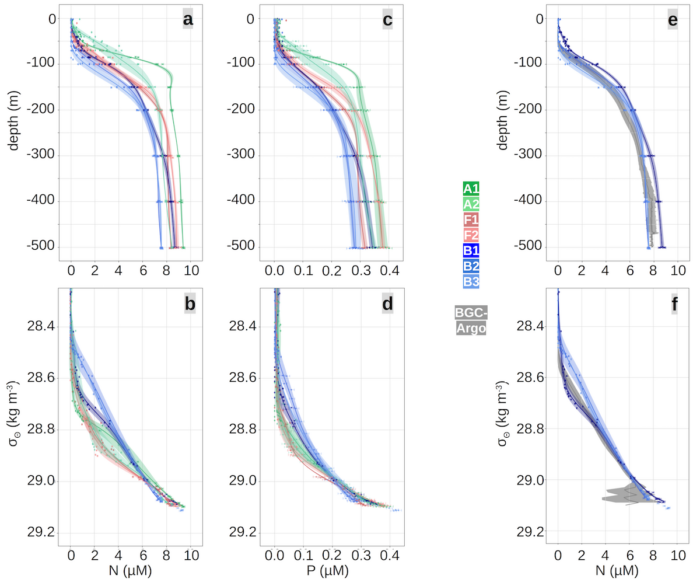
Nutrient concentration profiles for nitrates (N) and phosphates (P). Credits: Joël et al. 2026
Two different mechanisms are likely to explain how the eddy contributed to nutrient redistribution across distinct scales, first by an accumulation deep inside the eddy, and then through lateral diffusion outside the eddy. “The anticyclonic circulation of the eddy induces an accumulation of water at the center of the eddy as evidenced by the highest ssh patch in the zone. This process is at the origin of the deepening of isopycnals. Nutrients are therefore displaced deeper, outside of the photic layer and become unavailable for the photosynthesis” says Aude Joël, PhD candidate in Oceanography at Aix-Marseille University and first author of the paper. “A deep reservoir of nutrient is then constiuted by the eddy, that becomes a supply for surrounding waters, in and across the front, through lateral diffusive fluxes (i.e through difference of nutrient gradient and thanks to the presence of the eddy that generate stirring and horizontal turbulence)”.
The proposed mechanism is especially crucial in oligotrophic regions, where nutrients are scarce and rapidly consumed by primary production within the sunlit layer. “In oligotrophic conditions, even the slightest injection or removal of nutrients can significantly impact local productivity. Such processes may either further enhance oligotrophic conditions or, conversely, provide an additional nutrient supply. In more energetic regions, other mechanisms, such as upwelling, also play a role and likely dominate over the effects of small fine-scale structures like this type of eddy. The study of these interactions in oligotrophic region is quite important since they represent about 70% of the global ocean” says Joël.
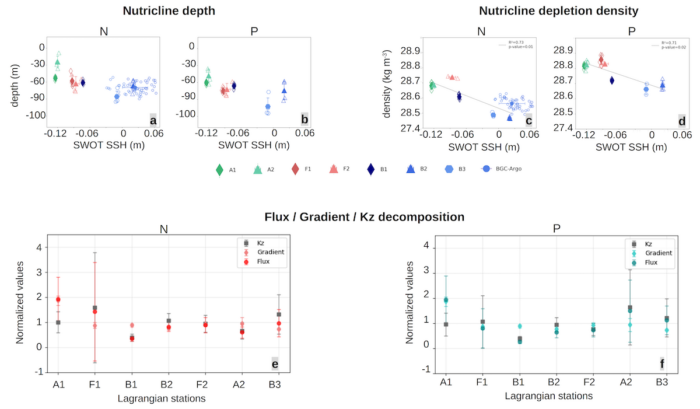
Nutricline depth and density. Credits: Joël et al. 2026
The Mediterranean Sea as a laboratory for the impacts of climate change
Previous works linking SSH and subsurface nutrient structure at mesoscale demonstrated regional and seasonal variability in physical–biogeochemical coupling, with complex implications for ecosystem functioning. The significant relationship identified in this study between SWOT SSH and nutricline properties in density space reveals this coupling at unprecedented resolution. It highlights fine-scale features as active drivers of nutrient distribution and supports the view that physical fine-scale dynamics shape important nutrient pathways in oligotrophic seas where ecosystems are highly sensitive to nutrient availability and highly dynamic.
“Recent modelling studies have indicated that the global ocean will become more and more oligotrophic due the global warming: The Mediterranean Sea can be seen as a laboratory to study the effect of climate change for that matter’ says Joël.
Under climate change, the oligotrophic conditions typical of the Mediterranean Sea are indeed expected to expand to other regions of the global ocean. Giving the ubiquity of fine scales in the ocean, this work represents an important contribution in understanding the evolution of biogeochemical processes in the future.
The work was supported by French spatial agency Centre Nationales Etudes Centre National d’Etudes Spatiales (CNES) and the French National Research Agency (BIOSWOT ANR-23-CE01-0027).
Citation: Joël, A., Doglioli, A. M., Bosse, A., Bouruet-Aubertot, P., Buniak, L., Capet, X., et al. (2026). Ocean circulation modulating the nutrient distribution and fluxes at regional and fine scales: A case study in the Northwestern Mediterranean Sea. Geophysical Research Letters, 53, e2025GL120726. https://doi.org/10.1029/2025GL120726
Contact:
Other papers from the BioSWOT-Med campaign
Investigating zooplankton at SWOT scales in the NW Mediterranean: a legacy of François Carlotti
BioSWOT-Med Campaign | BioSWOT-Med Blog
