Physical oceanographer studying trapped waves that travel along Atlantic coastlines and the equator connecting remote regions.
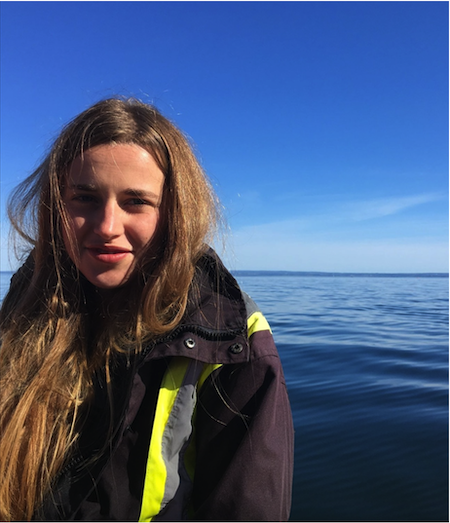
Léa Poli is a CNES postdoctoral researcher at Mercator Ocean International, where her research focuses on the tropical Atlantic. Before that, she did her PhD at LOCEAN, Paris, France, studying topographically related dynamics in the Argentine Basin.
SWOT AdAC: What is your field of research and how did you choose it?
Léa Poli: I am a physical oceanographer with a strong interest in flows confined along boundaries, such as the equator and the continental slopes. In particular, I study trapped waves in the Atlantic that propagate along coastlines and the equator and can carry energy over thousands of kilometres, connecting remote regions.
These waves strongly influence the variability of coastal and slope regions. They are associated with large vertical displacements of the thermocline. During the negative phase, the thermocline rises, creating upwelling: cold water cools the surface and increases the nutrient flux toward the surface, which affects ecosystems. During the positive phase, the thermocline deepens, contributing to the export of heat to deeper layers. These waves likely play a role in extreme coastal events, such as deep marine heatwaves, which can seriously harm ecosystems and human activities.
They have a sea level signature, and the associated current anomalies modulate the mean currents. This changes the horizontal distribution of heat and nutrients, so the waves can modify the background state of the ocean.
I chose physical oceanography because I am passionate about how the Earth system works and how it connects to society.
SWOT AdAC: How does your research relate to SWOT?
LP: Trapped waves have a sea level signature. SWOT provides, for the first time, fine-scale and high-precision observations of sea level close to the coastline, a region where conventional altimetry has long been limited. In addition, the daily-repeat (fast-sampling) phase offered a first opportunity to observe the high-frequency signature of trapped waves.
SWOT AdAC: What do you find exciting about SWOT and the SWOT AdAC campaign in which you participated?
LP: I did not take part in any SWOT AdAC campaign, but I used data from the mooring deployed along the Brazilian coast during the Abrolhos-SWOT AdAC campaign. I analysed its bottom pressure measurements, converted them to sea level, and placed them in the regional observational context using tide gauges along the coast. This let me follow the propagation of trapped waves and validate model outputs.
Building on this, I am co-organising a new field campaign within the CNES SWOT-SWATI project, together with the LEFE-funded DOCE project. This winter, two moorings will be deployed for one year along the Brazilian coast, under two SWOT swaths, to track trapped waves and their interactions with the surrounding circulation. These measurements will let us link the sea level observed by SWOT to subsurface velocities
SWOT AdAC: What are your plans once you finish analysing SWOT data?
LP: My analysis of SWOT data is still ongoing. I use it together with model outputs and in-situ measurements to build a three-dimensional view of the ocean.
Next, I plan to use Mercator Ocean products, with and without SWOT assimilation, to assess the impact of SWOT observations on the representation of trapped waves. I will also use the global 1/36° model including tides, together with regional high-resolution configurations, to analyse how trapped waves behave and interact with other components of the circulation.
I am particularly interested in the interaction between trapped waves and internal tides. Internal tides contribute significantly to ocean mixing, a key component of the climate system, and their coupling with trapped waves remains poorly understood.
SWOT AdAC: Besides SWOT, are you involved in any other exciting research that you would like to share?
LP: Besides SWOT, I am interested in the role of ocean boundaries, such as coastlines, in the energetic adjustment of ocean basins, and in how information and energy are redistributed along the coasts. Trapped waves connect remote regions with a time lag, which opens a potential window of predictability. Using their propagation time as a precursor signal could improve our ability to anticipate regional ocean variability and coastal extreme events, such as marine heatwaves. This is crucial in the context of climate change. I am also interested in how these waves and their impacts will evolve under ocean warming scenarios.
Discover Léa’s work on High-frequency Coastal Trapped Waves over the Patagonian Shelf.
Meet more early career researchers
