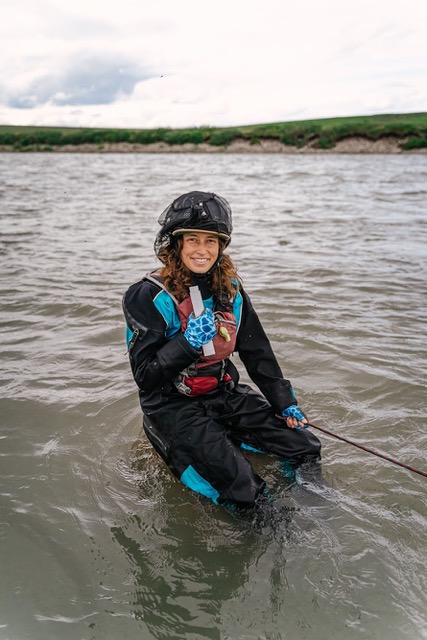
Computational hydrologist with a focus on river discharge, sediment, and river greenhouse gas contribution.
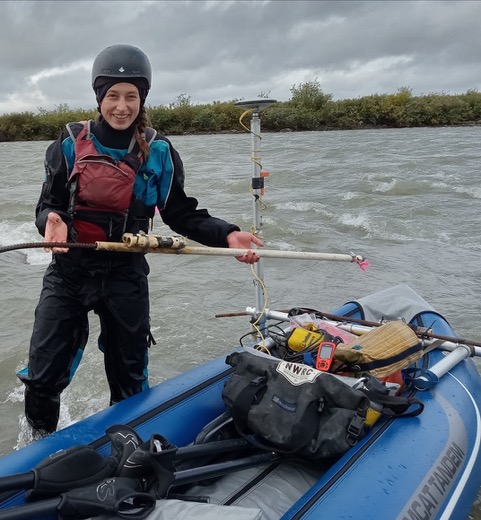
Elisa Friedmann is pursuing a PhD in in Environmental and Water Resources Engineering at the University of Massachusetts at Amherst. She previously earned a B.S. in Biochemistry with a Certificate in Environment and Sustainability as well as a B.A. in Plan II Honors at the University of Texas at Austin.
SWOT AdAC: What is your field of research and how did you choose it?
Elisa Friedmann:I study rivers – both river water quantity and river water quality. I would describe my field broadly as computational hydrologist with a focus on river discharge, sediment, and river greenhouse gas contribution.
I chose this field because I am extremely passionate about rivers both as a career and as a hobby. This passion was born from experiences at my undergraduate university, where I co-founded a citizen science organization that taught students to monitor water quality as well as canoeing in remote areas to collect the data. The combination of science, experiential education, and service inspired me to pursue a graduate degree after spending a few years as a whitewater raft guide where I led multiday wilderness trips in the Western United States and in Chile.
SWOT AdAC: How is your field of research related to SWOT?
EF: My field is directly related to SWOT, especially SWOT validation and SWOT discharge estimation. My lab is heavily involved in these two SWOT sub-projects and I have both accomplished field work and published research in these two areas. Our lab specifically focuses on using remote sensing techniques to estimate discharge and has pioneered both theory and application of these methods. SWOT lends itself well to this area due to its concurrent estimation of parameters otherwise unmeasured and its large scale. Now we have fewer ‘unknowns’ if you will to compute discharge, and we can do it everywhere SWOT gathers data.
SWOT AdAC: What do you find exciting about SWOT and the SWOT campaign during the fast-sampling phase in which you participated? How did you contribute to the campaign and to the analysis of the data collected?
EF: Rivers are extremely challenging to observe and model in real time because they are highly heterogenous as they accumulate and integrate changes along their length. While it is difficult to disentangle the many factors that explain river behavior despite our dependence on them, SWOT is ambitious enough to finally observe them directly which cannot be said for other earth observing satellites.
The other exciting thing about SWOT is the scale at which it takes measurements. This satellite can both improve large river monitoring at specific reaches that would otherwise be unreachable as well as improve regional and global water budgets. In terms of the latter (which is my focus), this kind of work allows us to ask big questions about regional and continental water movement which is important when formulate large scale responses to changes in our climate. When countries or summits make decisions on the future direction of climate policy, SWOT can be used to answer the basic who, what, when, where, and why of water movement within and between countries that we previously could only provide an educated guess about. These kinds of answers are still in the future as we explore the new data, but I believe this is an important potential for SWOT derived products.
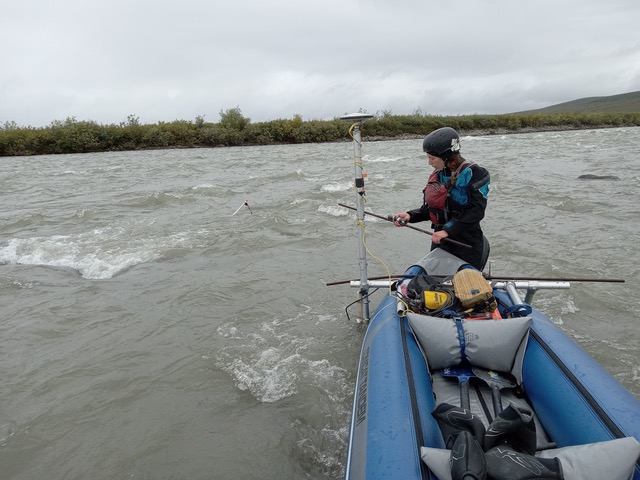
My contribution to the field campaign and analysis occurred at one site and as published research. My field work included leading the SWOT validation effort on the Sagavanirktok River in Northern Alaska, paddling boats to install instruments and collect water surface elevation profiles. My own technical research assesses the discharge product during this validation period globally, seeking to understand the effect of the daily orbit on discharge estimation at these reaches.
SWOT AdAC: What are your plans after you’ve finished analysing SWOT data?
EF: I have just submitted a paper on the discharge product partly using the SWOT validation campaign. I am excited to be part of further community efforts as well as pursue other personal projects advancing SWOT discharge and elevation data as they pertain to river health, river water quality, and water stress in remote areas.
SWOT AdAC: Besides SWOT, are you involved in another exciting research and do you want to share something about it?
EF: I am also involved in using optical satellite data fusion to assess water quality globally, especially sediment. Adding multiple satellite sources is complex, but can alleviate the space and time tradeoffs that arise from orbit and resolution to create useful data products. Using information from many different missions has so much potential to improve our understanding of rivers and water resources!
Campaign / Project: SWOT River Validation Campaign, SWOT Discharge Product