Hydrologist focusing on how rivers work and how their behavior is shaped by the surrounding landscape.
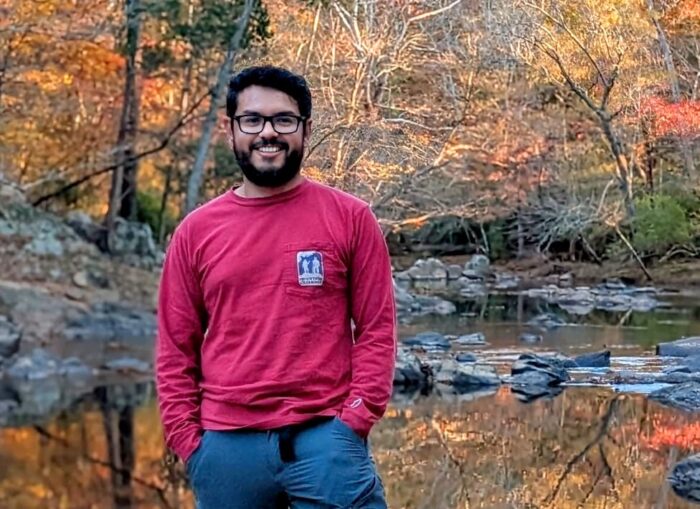
After completing a master’s degree in Environmental Engineering at the Universidad de Antioquia in Medellín, Colombia, J. Daniel Vélez Castaño was awarded a Fulbright scholarship that opened the door for him to begin a PhD at the University of North Carolina at Chapel Hill. He is now a researcher in the Global Hydrology Lab, where he works under the guidance of Professor Tamlin Pavelsky.
SWOT AdAC: What is your field of research and how did you choose it?
J.Daniel Vélez: Rivers are complex and dynamic systems. Despite decades of research, we still only partially understand how they function and how their behavior evolves through time. Even with strong theoretical frameworks, there is still a long way to go in fully characterizing and predicting processes such as discharge variability, flooding, avulsions, and changes in channel geometry.
My research focuses on how rivers work and how their behavior is shaped by the surrounding landscape. In particular, I study the links between hydraulic geometry and river morphology, how properties like width and water surface elevation relate to planform characteristics, valley confinement, lithology, sediment size and cohesion along the banks, riparian vegetation, rainfall patterns, and other environmental controls.
I entered the world of rivers through hydraulic engineering, working with flow and flood models that helped me understand how rivers behave in real and practical ways. That experience was extremely valuable and gave me the technical foundation I still rely on today. Over time, it also made me interested in broader scientific questions, how rivers develop their shape, how their geometry evolves, and how these patterns vary across landscapes.
Understanding that engineering gave me one essential perspective, while scientific research could offer another, is what motivated me to move into my current field. This transition naturally led me toward river morphology, hydraulic geometry, and eventually satellite remote sensing, where missions like SWOT allow us to study rivers at regional to global scales.
SWOT AdAC: How is your field of research related to SWOT?
JDV: SWOT offers many breakthroughs, but for my work the most important one is its ability to retrieve river width and water surface elevation simultaneously. Having both variables observed at the same time and at high spatial resolution is something we have never had at global scale. This capability allows me to construct hypsometric curves, relationships between width and elevation, that provide information on average riverbank slopes and how channel geometry changes across the landscape.
These observations directly support my research on hydraulic geometry, river morphology, and the connections between channel form and the environments through which rivers flow.
SWOT AdAC: What do you find exciting about SWOT?
JDV: What I find particularly exciting about SWOT is its ability to reveal, for the first time, how river geometry evolves at global scale and at approximately 200-meter spatial resolution. This opens the door to studying hydraulic geometry and channel morphology in ways that were not possible with previous satellite missions or in situ networks.
SWOT AdAC: What are your plans after you’ve finished analyzing SWOT data?
JDV: Once I finish analyzing SWOT data, I plan to use the hydraulic properties extracted from the width–water surface elevation curves, such as bank slope and the structure of the curves, to study how these properties vary along rivers and across regions. My goal is to examine spatial patterns, identify where these relationships remain coherent, and explore how they relate to river morphology and landscape variables. My long-term goal is to determine whether landscape controls can predict river form, using SWOT as the foundation for global-scale analyses.
Campaign / Project: SWOT River Morphology and Hydraulic Geometry