Early careers or senior researchers, many women contributed to the success of the SWOT AdAC initiative. The International Day of Women and Girls in Science, celebrated on February 11th, is a great occasion for looking back at some memories from SWOT AdAC campaigns.
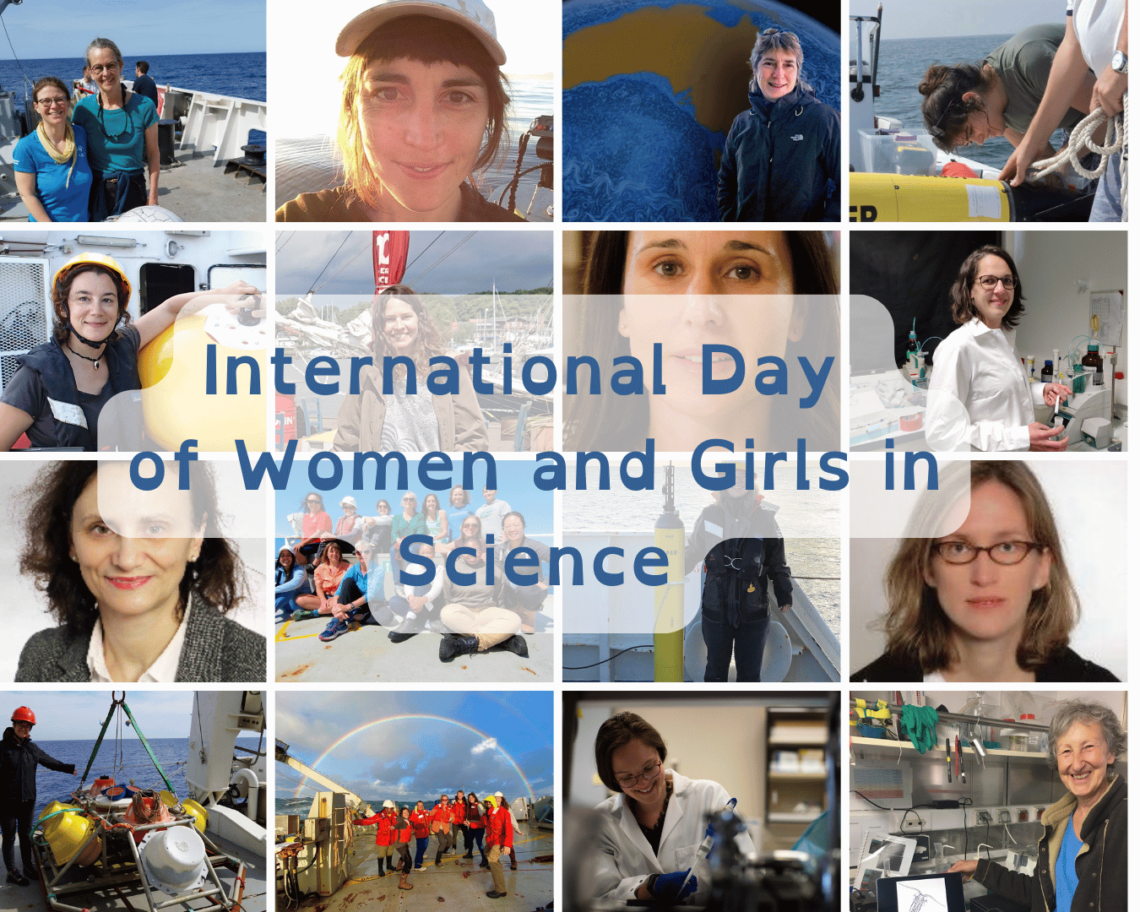
The International Day of Women and Girls in Science (IDWGS), celebrated 11 February, was established by the UN General Assembly in 2015. IDWGS is implemented by UNESCO and UN-Women, in collaboration with institutions and civil society partners that aim to promote women and girls in science. This Day is an opportunity to promote full and equal access to and participation in science for women and girls.
2025 marks the 10th anniversary of the International Day of Women and Girls in Science (IDWGS). On this day, every year, we recognize the incredible contributions of girls and women in STEM (Science, Technology, Engineering, and Mathematics). From groundbreaking research to innovative solutions that shape our world, their impact is undeniable.
Yet, barriers still exist—gender biases, lack of representation, and unequal opportunities continue to hinder progress. It’s time to change that. We must foster an inclusive environment where every girl knows that she belongs in STEM and that her ideas can transform the future.
Masters’ and PhD students, postdocs and senior researchers, many women took part in the planning and execution of SWOT AdAC campaigns, contributing to their success. In this day, we take the occasion to look back at some of their contributions starting from news and resources available on SWOT AdAC website.
The new wave of oceanographers …
Many early career researchers took part in planning and execution of SWOT AdAC campaigns and are currently analyzing the data collected. Many of them were women and some were featured, along with their men colleagues, in a series of interviews “The new wave of oceanographers” where they explained their research objectives and their links with SWOT. Many also contributed to blog campaigns and are featured in short documentaries.
… in the Atlantic Ocean and on the Patagonian Continental Shelf
At least 14 women were part of Science Team of the QUICCHE campaign that was carried out at the SWOT crossover in the Cape Basin. At the time, Michaela Edwinson was a master student focusing atmospheric and oceanic coupling processes in the Cape Basin, while Estel Font was a pursuing a PhD in physical oceanography, using underwater autonomous vehicles to look at fine scale dynamics. In the same research group Polar Gliders at the University of Gothenburg, Isabelle Giddy was a post-doctoral researcher studying the role of wind-driven turbulence in mediating momentum and heath flux in the Southern Ocean.
Ali Johnson was a graduate student at the School of Oceanography, Rhode Island University, while Tesha Toolse was affiliated with the Southern Ocean Carbon and Climate Observatory. Sijing Shen was pursuing her PhD at the School of Ocean science, Bangor University, and during the QUICCHE she concentrated on the impact of warm and salty Indian Ocean water leakage into the Cape Cauldron region of the southeast Atlantic.
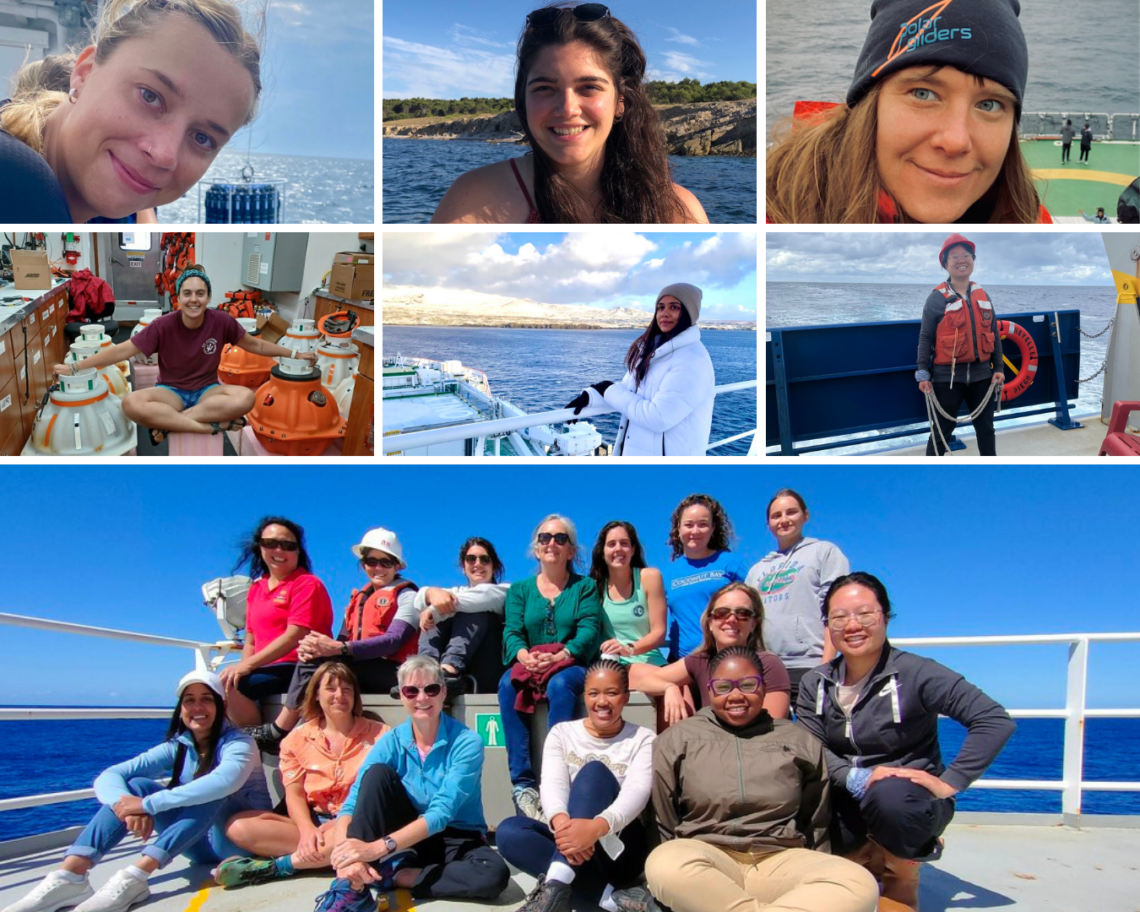
From left to right, top to bottom: Michaela Edwinson, Estel Font, Isabelle Giddy, Ali Johnson, Tesha Toolse, Sijing Shen and all the women in QUICCHE’s science team.
Laura Ruiz-Etcheverry took part in Patagonian Continental Shelf campaign. Expert in sea level anomaly dynamics, she contributed to validation of SWOT altimetry data.
… in the Pacific Ocean
Babette Tchonang contributed to the California Cal/Cal campaign, whose goal was to determine what is the role of finescale processes in connecting the surface of the ocean and its interior.
Sarah Lang contributed to the S-MODE campaign, which was also carried out offshore California. During S-MODE, extensive observations of “submesoscale” ocean eddies were carried out, so to assess their role in vertical transport were. In particular, Sarah focused on how submesoscale ocean dynamics affect phytoplankton communities and plankton distribution.
Peiran Yang contributed to the Northwest Pacific campaign. She was a postdoctoral researcher investigating the dynamics of mesoscale and submesoscale processes focusing on the generation of eddy heat transport and its impact on climate in the North West Pacific.
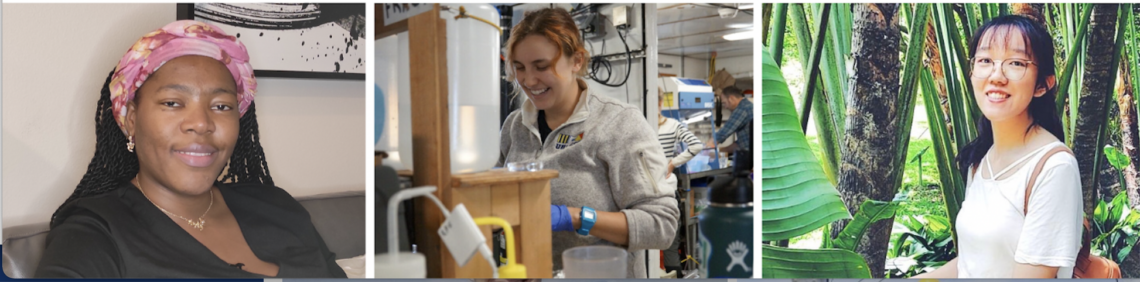
Babette Tchonang (left), Sarah Lang (center), and Peiran Yang (right).
In the Mediterranean Sea …
Lénaïg Brun and Margot Demol were PhD students during the SWOT fast-sampling phase and took part in the C-SWOT-2023 campaign. C-SWOT-2023 focused on the low trophic levels (nutrients and phytoplankton) of the marine food web, trying to highlight where and when “physics is brought to life” in the NW Mediterranean Sea. Both Lénaïg and Margot developed expertise in emerging finescale observing systems, inversion methods, data assimilation.
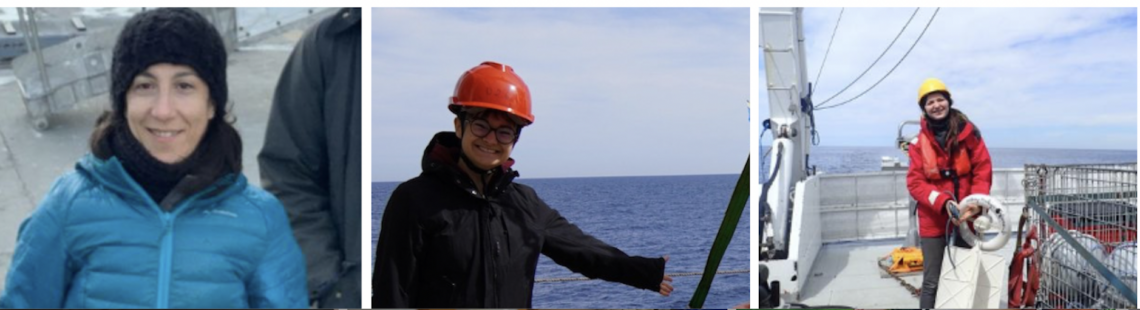
From left to right: Laura Ruiz-Etcheverry, Lénaïg Brun, and Margot Demol.
Laura Giraud (Masters’s student), Caroline Comby, Laurina Oms and Emily Wagonner (PhD students) were all onboard R/V L’Atalante during the Bio-SWOT-Med campaign. Laura focused on the marine biogeochemistry in the Mediterranean Sea; Caroline on the issue of vertical velocity measurements in the context of fine-scale dynamics; Laurina investigated the distribution of phytoplankton in the ocean by studying both ecological processes and physical structures at fine scales and Emily focused on understanding the various forms of phosphorus that can be used by phytoplankton.

At the time of SWOT fast-sampling phase, Bàrbara Barceló-Llull was a postdoctoral researcher at IMEDEA, Spain. She contributed to the FaSt-SWOT campaign focusing on in situ and satellite ocean observations to understand mesoscale and submesoscale dynamics as well as the inference of vertical motions and their impact on marine ecosystems. To help in planning the sampling strategy for FaSt-SWOT, Bàrbara used the EuroSea OSSEs tool (observing system simulation experiments (OSSEs) to plan and evaluate in situ sampling strategies including CTD observations from different platforms) that she had previously developed.
Elisabet Verger-Miralles (PhD student) and Laura Gómez-Navarro (postdoc), also took part in the FaSt-SWOT campaign.

From left to right: Bàrbara Barcelò-Lull, Elisabet Verger-Miralles, and Laura Gómez-Navarro.
… and in the Baltic Sea
In the Baltic Sea, Natalia Herrán, physical oceanographer and geomorphologist contributed to the CONWEST-DYCO (Circulation and Mesoscale Dynamics of the Eastern Gotland Basin – model comparison and coupling of high resolution in situ observations combined with Surface Water and Ocean Topography satellite (SWOT) and regional ocean models), investigating the overturning circulation of the Baltic Sea.
In the Southern Ocean … and supporting all SWOT AdAC campaigns
Andrea Hay took part in the Bass Strait, Southern Ocean (SOTS) and Great Barrier Reef (Davies Reef) campaign. The goal of the campaign was to step into into finer scale in situ geometric calibration of higher resolution altimetry and linking the geodetic validation to finer scale processes. She contributed to in situ validation of altimetry measurements as part of her PhD.
Louise Rousselet, the SWOT AdAC science officer, worked with Consortium members to support their in situ campaigns to compare results from different sites and develop near real-time sampling strategies. She also was responsible for the implementation of the SPASSO software (Software Package for an Adaptive Satellite-based Sampling for Oceanographic cruises) which provided daily maps of satellite data and Lagrangian diagnostics that allow to guide in real time the campaigns in a region of interest through the analysis of environmental parameters detected by satellite.

From left to right: Natalia Herrán, Andrea Hay, Louise Rousellet.
Senior researchers
Several women were coordinators of working groups, principal investigators, and contact points of SWOT-AdAC campaigns.
Alice della Penna, Anne Petrenko, Elvira Pulido, Laure Chirurgien, Magali Lescot, Maristella Berta, Morgane Didry, Sandra Nunige, Stéphanie Barillon, and Véronique Cornet participated in the BioSWOT-Med campaign.

From left to right, top to bottom: Alice della Penna, Anne Petrenko, Elvira Pulido, Laure Chirurgien, Magali Lescot, Maristella Berta, Sandra Nunige, Stéphanie Barillon, Véronique Cornet.
Ananda Pascual (IMEDEA, Spain) was principal investigator and contact point for the FaSt-SWOT campaign, whose goal was to understand what is the role of fine scales in horizontal and vertical exchange in the upper ocean.
Bettina Fach (Institute of Marine Science, Middle East Technical University, Turkey) was principal investigator and contact point for the Marmara Sea and Black Sea campaigns, which had the goal to understand how finescale processes interact in water mixing at the interface between Black Sea water and Mediterranean Sea water.
Kyla Drushka (University of Washington) was part of the SWOT Science Team and developed the Oceanliner tool (observing system simulation experiments (OSSEs) to subsample high-resolution model output as if by gliders, ships, or other in situ platforms).
Lisa M Beal (RSMAS, USA) was principal investigator and contact point for the QUICCHE (QUantifying Interocean fluxes in the Cape Cauldron Hotspot of Eddy kinetic energy) at Cape Basin, in the southeast Atlantic, a global hotspot of eddy kinetic energy, fed by a leakage of waters from the subtropical Indian Ocean via the Agulhas Current.
Luciana Fenoglio (Institute of Geodesy and Geoinformation, University of Bonn) was the contact point for the CONWEST-DYCO and the Elbe Estuary and Western Baltic Coast campaigns.
Nicole L Jones (University of Western Australia) was the contact point for the North West Australia Shelf campaign, which focused on quantifying vertical and lateral ocean transport due to submesoscale fronts and eddies.
Rosemary Morrow (at the time at LEGOS, France), was the contact point for SURVOSTRAL campaign as well CNES project scientist for the SWOT altimetry- interferometry mission.
Sophie Cravatte (IRD), was the contact point for the SWOTALIS campaign in New Caledonia that studied the internal tides and mesoscale interactions in the South-West Tropical Pacific Ocean and how these fine-scale processes affect this area of important biodiversity.
Tosca Ballerini (Thalassa, France) took care of SWOT AdAC website.
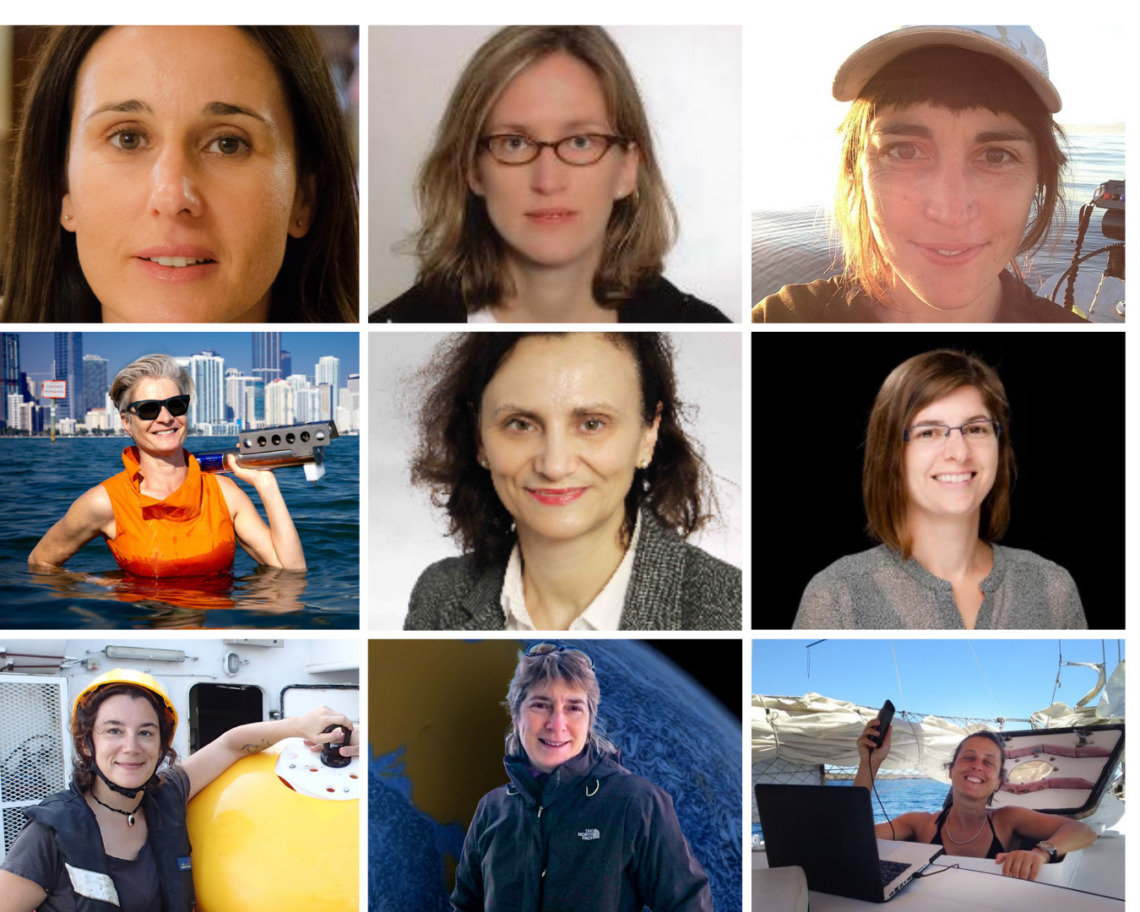
From left to right, top to bottom: Ananda Pascual, Bettina Fach, Kyla Drushka, Lisa M Beal, Luciana Fenoglio, Nicole L Jones, Sophie Cravatte, Rosemary Morrow, Tosca Ballerini.
This is list is not exhaustive. To learn about other women (and men!) involved in the SWOT AdAC experiment, visit the Early Career Researchers, Science and Data Officer and the Steering Group pages, go checking the campaigns blogs and watch the documentary “From space to the Mediterranean: Chasing ocean currents”.
To add new researchers and pictures, please send an email to