Publications News
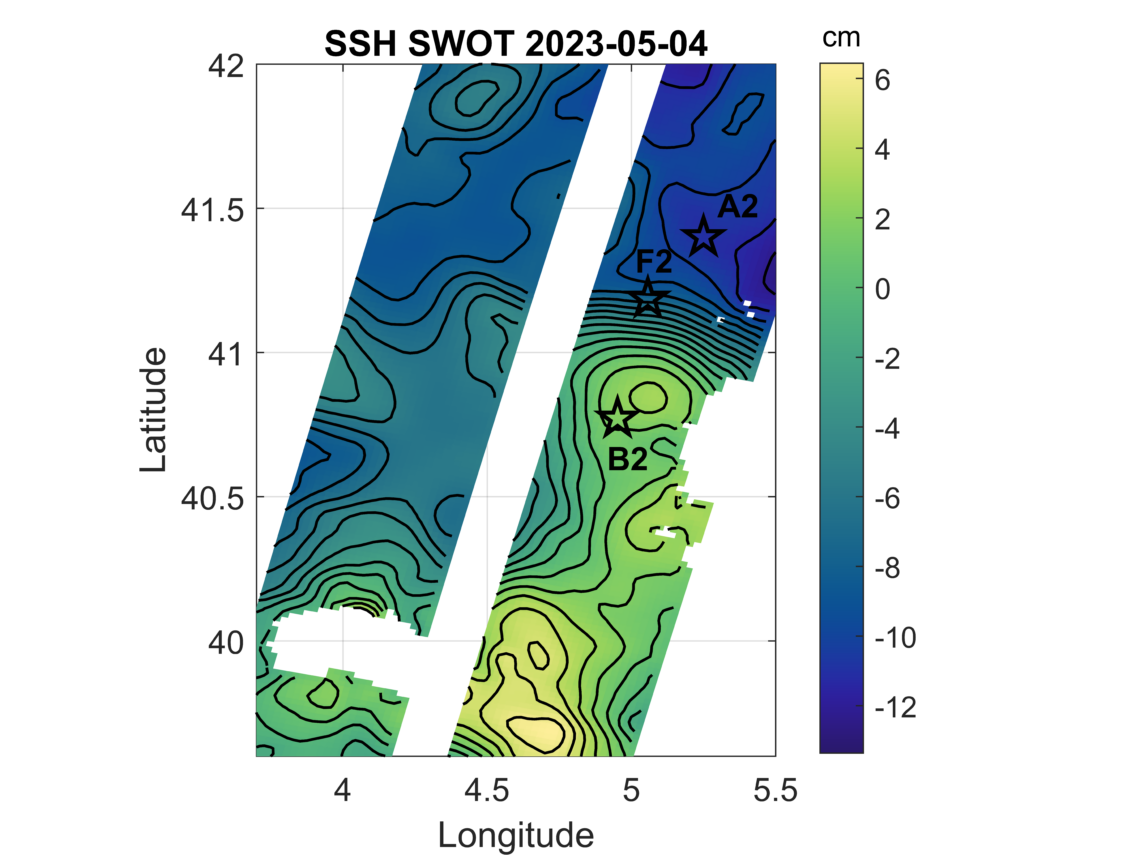
SWOT-guided sampling reveals distinct phytoplankton communities within a fine-scale front. An adaptive, multidisciplinary sampling strategy guided by SWOT images across a fine-scale front in the North Balearic Sea revealed distinct phytoplankton communities within the front. Unlike highly productive, dynamic regions of the global ocean where opportunistic groups dominate at fronts, a study published on Communication Earth and Environment found that non-dominant groups increased their relative contribution within the front compared to adjacent waters. These results underscore the role of fine-scale variability in maintaining community heterogeneity, suggesting that fronts may act as refuges for non-dominant phytoplankton groups in moderately energetic, oligotrophic conditions.
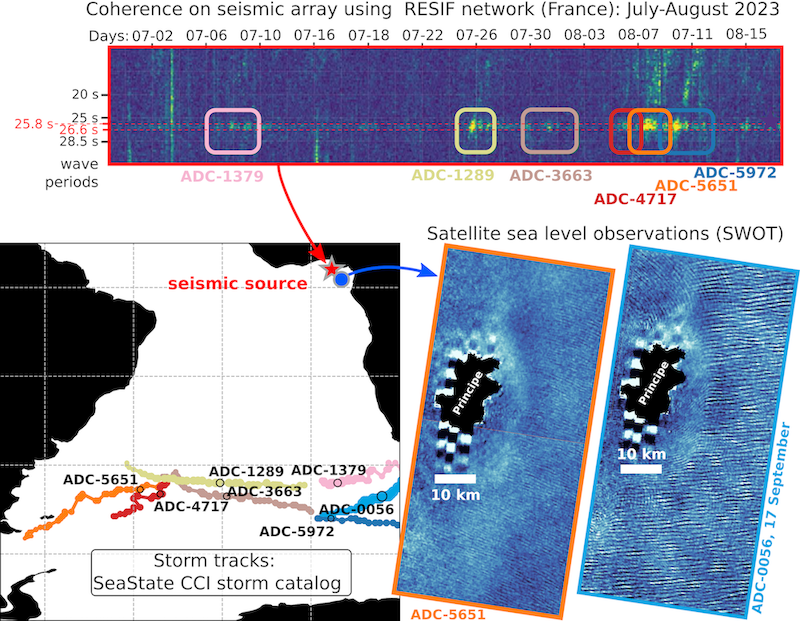
SWOT reveals swells that connect ocean storms and mysterious seismic activity. A study published in the journal Nature Communications identifies a causal relationship between the occurrence of large storms in the Southern Ocean and, a few days later, bursts of microseisms with periods around 16 and 26 s, radiating from the Gulf of Guinea. The hidden link between these two phenomena are swells radiated from the storms and revealed in sea surface height maps by the SWOT satellite. Interview with Fabrice Ardhuin, SWOT project investigator and co-author of the paper.
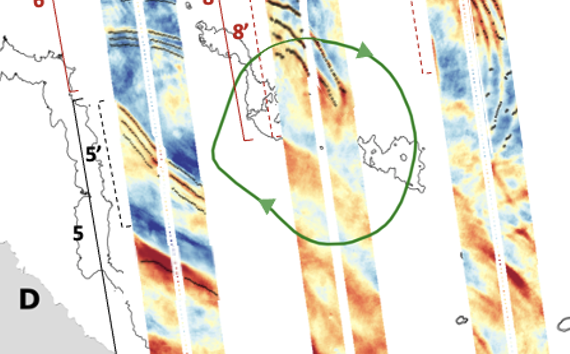
Nonlinear responses from the interaction of internal solitary waves and eddies observed for the first time with SWOT satellite. Internal solitary waves impact physical and biological processes in the upper ocean, as well as human activities with potential impacts on navigation and coastal infrastructures. For the first time, thanks to the SWOT satellite, it was possible to observe their signature in sea surface height. This allowed researchers to study the interactions of internal solitary waves with eddies on the Amazon Shelf, leading to a better understanding of their complex interactions.
SWOT reveals that fine-scale eddies are as efficient as larger and more energetic structures in modulating turbulence in the ocean interior. Using data collected during the fast-sampling phase of the SWOT satellite, a study published on Journal of Geophysical Research: Oceans shows that fine-scale eddies (<100 km) in the Northwestern Mediterranean Sea are as efficient as large and intense structures found in western boundary currents and the Antarctic Circumpolar Current system in transferring wind energy into the ocean interior. These findings might apply to the rest of the global ocean characterized by low energy and thus provide a new challenge to parameterize this process in Earth system models.
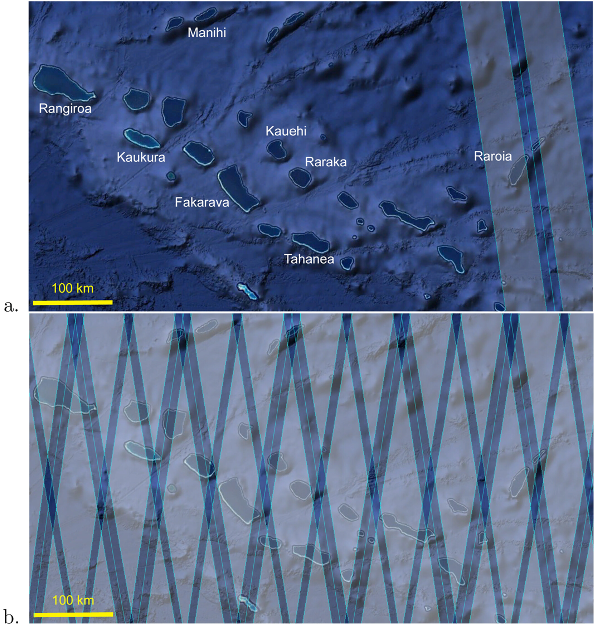
SWOT effectively captures the presence of seiche-like structures in French Polynesia lagoons. Using data collected with the SWOT satellite, a study published on Geophysical Research Letters describes the spatial structure of low amplitude oscillations, known as seiches, in the lagoons of several atolls in the French Polynesia. This ability to detect seiche-like structures in small bodies of water (less than 80 km in length) is unprecedented in satellite altimetry and opens up new avenues of research into these events and their contribution to erosion and flooding in remote locations.
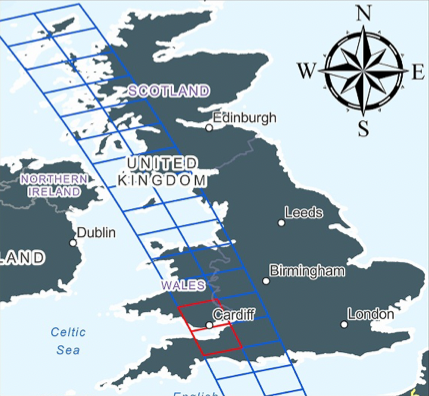
SWOT extends reliable observations of water surface elevation into challenging coastal environments. The validation of SWOT data in the Bristol Channel and Severn Estuary, UK, shows that SWOT efficiently captures coastal hydrodynamics, revealing high accuracy in the measurement of water level across diverse tidal conditions. With appropriate filtering and processing strategies, SWOT data are suitable for many applications of societal relevance.
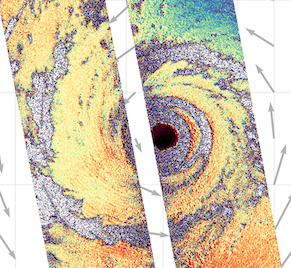
SWOT can map the spatial structure of storm surges across diverse oceanic regimes. Analyzing SWOT data collected during three extreme weather events, a paper published on Geophysical Research Letter demonstrates the capability of SWOT to capture the spatial structure of storm surges across diverse oceanic regimes. Results confirm how SWOT represents a major advancement in coastal oceanography, with strong potential to improve scientific understanding, risk assessment, and long‐term coastal resilience. An interview with Diego Vega-Giménez, first author of the study.
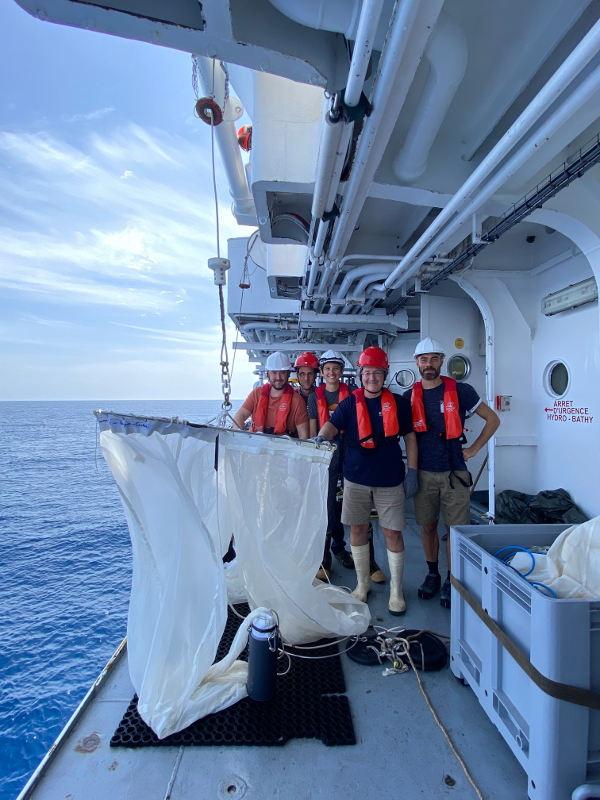
Investigating zooplankton at SWOT scales in the NW Mediterranean: a legacy of François Carlotti.The first detailed investigation of zooplankton distribution at fine scales in the North Balearic Front has been published in Biogeosciences. The work was carried out during the BioSWOT-Med cruise under the coordination of François Carlotti. François, who passed away earlier this January, has been a pioneer in the study of zooplankton from the polar oceans to the Mediterranean Sea.
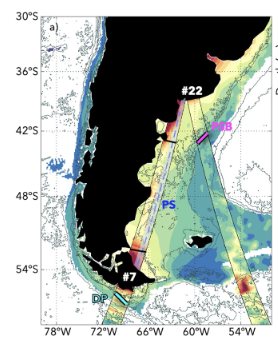
SWOT suggests the presence of high-frequency Coastal Trapped Waves over the Patagonian Shelf. Using data collected during the fast-sampling phase of the SWOT satellite, a study published on Geophysical Research Letters documents the presence of high-frequency Coastal Trapped Waves (with periods of 8-10 days) over the Patagonian Shelf. The Patagonian Shelf is characterized by a complex topography and Coastal Trapped Waves can play a significant role in modulating the currents and nutrient fluxes that influence its high productivity.
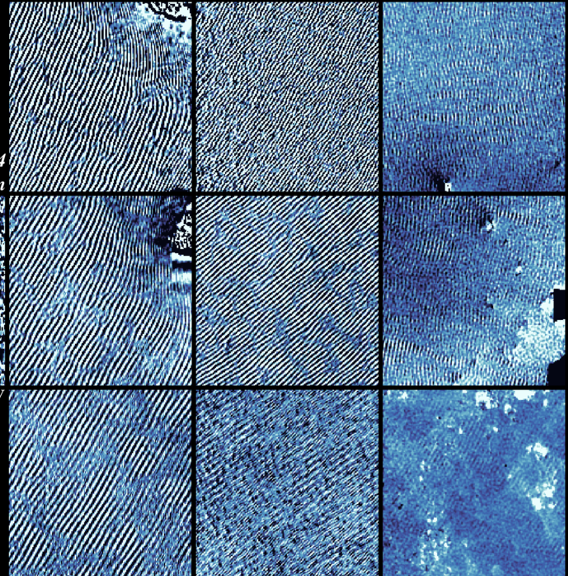
SWOT reveals the largest ocean waves. Building on the 34 years of wave height measurements by satellite and the capabilities of the new SWOT satellite, a study published yesterday on PNAS reveals a new record for the highest ocean waves ever measured in the open ocean and how these giant waves are formed. A commentary on the new findings with insights from Fabrice Ardhuin, lead author of the paper.